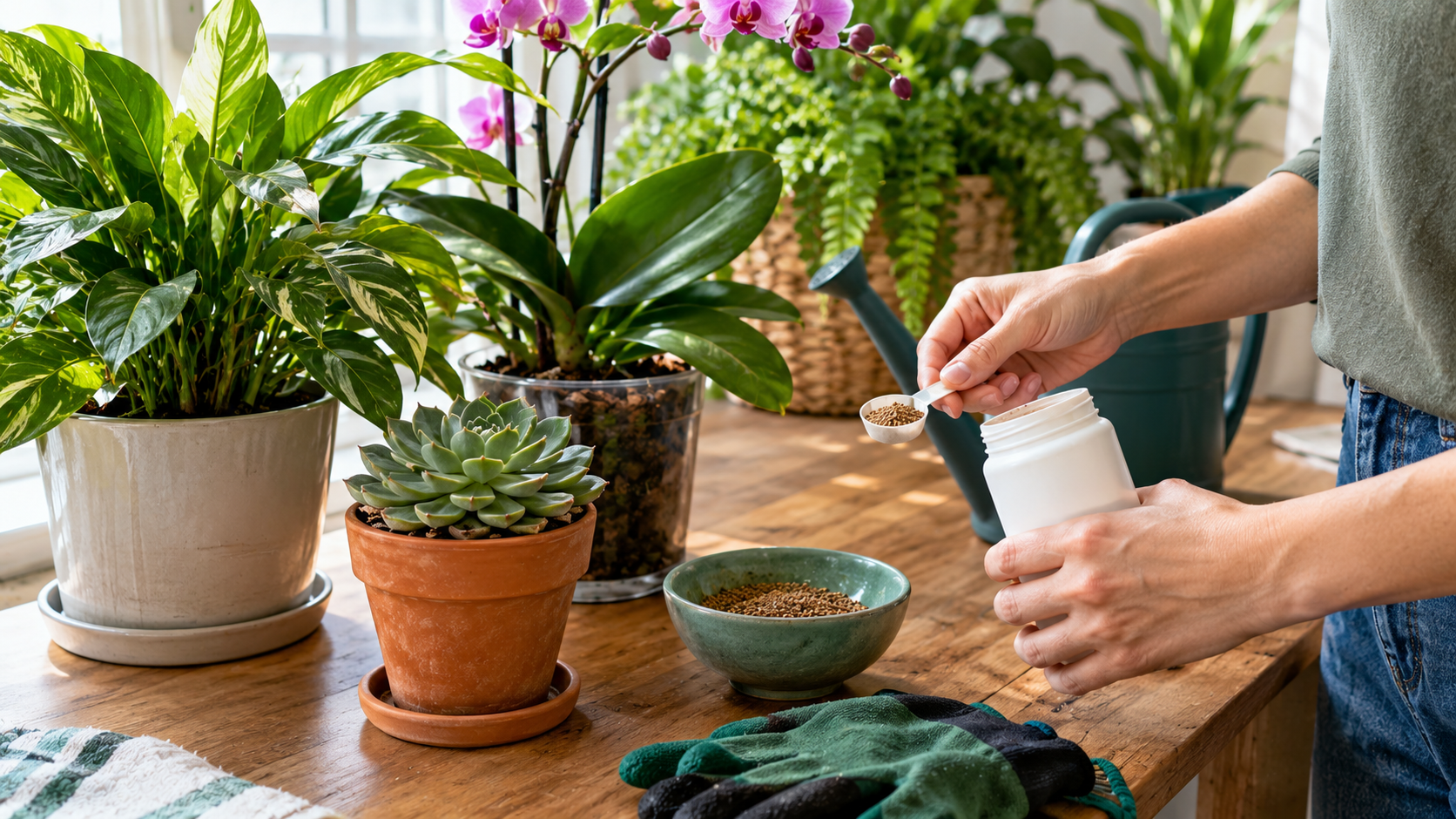
Choosing a fertilizer for houseplants can be confusing when garden centers offer liquid feeds, slow-release granules, organic products, and formulas designed for specific plants. Although fertilizer can support healthy growth, using the wrong product or applying too much may damage roots, cause leaf discoloration, or lead to excessive salt buildup in the potting mix.
The best approach is to understand what your plant needs before buying anything. Light, watering, soil conditions, species, and the season all influence how effectively a plant uses nutrients. By learning to read fertilizer labels, select an appropriate formula, and follow application instructions, you can feed your houseplants more safely and avoid unnecessary products.
Why Do Houseplants Need Fertilizer?
Plants require essential nutrients to develop roots, produce leaves, and maintain normal biological functions. Some nutrients, including nitrogen, phosphorus, and potassium, are needed in relatively large quantities. Others, such as iron, magnesium, and manganese, are required in smaller amounts.
In outdoor gardens, nutrients can enter the soil through decomposing organic matter and other natural processes. Houseplants, however, usually grow in containers with a limited amount of potting mix. Over time, available nutrients may become depleted, particularly when plants are actively growing or are watered frequently.
Fertilizer supplies nutrients that may be missing or insufficient in the growing medium. However, it does not replace adequate light, appropriate watering, healthy roots, or a suitable potting mix.
Important: A plant that is wilting, yellowing, or growing slowly does not automatically need fertilizer. These symptoms can also result from overwatering, underwatering, inadequate light, pests, or root damage. Identify the likely cause before adding nutrients.
How to Read a Fertilizer Label
Understanding the information printed on a fertilizer package is one of the most useful skills for choosing the right product.
What do the N-P-K numbers mean?
Most complete fertilizers display three numbers, such as 10-10-10 or 20-10-20. These represent the guaranteed percentages by weight of nitrogen (N), phosphate expressed as \(P_2O_5\), and potash expressed as \(K_2O\), respectively.
Each nutrient has a different role:
- Nitrogen (N): Supports leaf development and the production of chlorophyll, which plants use to capture light.
- Phosphorus (P): Contributes to energy transfer, root development, and reproductive processes.
- Potassium (K): Supports water regulation, enzyme activity, and several aspects of plant function.
A higher number does not automatically mean a better fertilizer. A concentrated formula can supply more nutrients per gram, but it can also increase the risk of overapplication if the dosage is not adjusted correctly.
For many leafy houseplants, a balanced or general-purpose fertilizer may be suitable. Flowering plants, orchids, succulents, and other specialized groups can have different nutritional requirements, so the species and growing conditions should guide the choice.
What does a complete fertilizer contain?
A complete fertilizer generally provides nitrogen, phosphorus, and potassium. Some products also contain secondary nutrients and micronutrients.
Check whether the label lists elements such as magnesium, iron, and manganese when these may be relevant to your plant. Not every product supplies every essential nutrient, and the need for additional nutrients depends on the growing medium, water quality, and plant species.
If your plant grows in a specialized medium, such as orchid bark, make sure the chosen fertilizer is appropriate for that growing system.
Choosing the Best Type of Fertilizer for Indoor Plants
Fertilizers differ in how quickly they release nutrients, how they are applied, and how much maintenance they require. The most suitable option is one you can measure accurately and use according to the needs of your plants.
Liquid fertilizer
Liquid fertilizer is mixed with water or supplied in a ready-to-use form. It is useful for people who want to adjust feeding frequency and dosage throughout the growing season.
- Suitable for many foliage plants and flowering houseplants.
- Easy to distribute across the potting mix when prepared correctly.
- Requires attention to dilution and application frequency.
This option can be practical for a collection containing several plants with similar nutritional needs. However, each species may still require a different concentration or feeding schedule.
Slow-release granular fertilizer
Slow-release products release nutrients gradually over a period specified by the manufacturer. They can reduce the need for frequent feeding, especially for plants that remain in containers for long periods.
The release rate may depend on temperature, moisture, and the product’s formulation. Do not add more granules simply because the plant appears to be growing slowly.
Organic fertilizer
Organic fertilizers may be made from plant-derived materials, animal-derived materials, or other organic sources. Some release nutrients gradually as microorganisms break them down, while others provide nutrients more readily.
Organic does not automatically mean harmless. Overapplication can still damage plants or contribute to nutrient pollution, and some products have odors that may be undesirable indoors. Choose a product suitable for houseplants and follow its label.
Specialized fertilizers
Certain plants benefit from products formulated for their particular growing requirements.
- Orchids: Use a fertilizer suitable for the orchid type and its growing medium.
- Cacti and succulents: Choose a product appropriate for plants with comparatively modest nutrient requirements.
- Flowering plants: Select a formulation suited to the species and its flowering stage rather than relying on the highest phosphorus number.
- Acid-loving plants: Where applicable, use a product designed for their specific nutrient and pH requirements.
The Royal Horticultural Society provides additional guidance on fertilizing houseplants and choosing suitable products.
How to Apply Fertilizer Safely: A Step-by-Step Guide
Before starting, gather the fertilizer, a clean measuring utensil, water if dilution is required, and the manufacturer’s instructions. Gloves may be appropriate depending on the product label.
- Identify the plant. Check its species or plant group and determine whether it needs regular feeding.
- Read the entire label. Confirm the intended plants, recommended dosage, application method, frequency, and any precautions.
- Check the potting mix. If it is completely dry, water the plant appropriately before fertilizing, unless the product instructions specify otherwise. Avoid feeding a plant with severely damaged or waterlogged roots.
- Measure accurately. Use the recommended quantity. Never estimate a concentrated liquid dose by eye or assume that a stronger mixture will work faster.
- Apply as directed. Distribute liquid or granular fertilizer according to the product’s instructions, keeping concentrated material away from leaves and stems when required.
- Record the application. Note the date and product so you can avoid feeding too frequently.
- Observe the plant. Monitor new growth, leaf color, and any signs of damage before the next scheduled application.
Never mix different fertilizers or other garden chemicals unless the labels explicitly permit it. Store products in their original containers, away from children and pets, and follow all safety instructions.
When Should You Fertilize Houseplants?
Most houseplants benefit from feeding when they are actively growing, provided they need additional nutrients. In many temperate climates, growth increases during spring and summer, but indoor conditions and local seasons can differ.
For plants growing in warm climates, the relevant period is the time when light, temperature, and moisture support active growth—not necessarily the same calendar months used in cooler regions.
Consider these situations:
- Actively growing foliage plants: May benefit from a suitable houseplant fertilizer at the labeled interval.
- Plants in fresh potting mix: Check whether the mix already contains starter fertilizer and how long it is expected to last.
- Dormant or slowly growing plants: Usually need less fertilizer because nutrient demand is reduced.
- Recently repotted plants: Check the new mix and the plant’s condition before adding more nutrients.
- Seedlings and cuttings: Need careful, age-appropriate feeding; concentrated fertilizer may injure young roots.
Do not assume that every plant needs fertilizer every week or every month. The product instructions, plant species, growing medium, and actual growth rate should determine the schedule.
Signs of Overfertilization and How to Correct It
Too much fertilizer can cause soluble salts to accumulate in the growing medium, making it harder for roots to absorb water. In severe cases, root damage can develop even when the soil appears moist.
Watch for these warning signs:
- Brown, scorched leaf tips or edges.
- A white crust forming on the surface of the potting mix or around the pot.
- Wilting despite adequate soil moisture.
- Sudden deterioration after a fertilizer application.
These symptoms can have other causes, so consider the plant’s recent care history before deciding that fertilizer is responsible.
If overfertilization is suspected, stop feeding and check the roots, drainage, and moisture level. If the pot drains freely and the plant is otherwise suitable for rinsing, water the growing medium thoroughly and allow excess water to drain away. Avoid this approach if the plant is already waterlogged or has serious root rot. In severe cases, replacing the growing medium may be necessary.
Do not add another product to counteract fertilizer damage without reliable guidance.
Common Fertilizing Mistakes to Avoid
Several habits can undermine an otherwise good plant-care routine.
- Using fertilizer to treat every yellow leaf: Yellowing may result from poor light, watering problems, pests, or unsuitable soil.
- Applying more than the recommended dose: Higher concentrations can damage roots rather than accelerate growth.
- Ignoring fertilizer already in the potting mix: Additional feeding may be unnecessary until the existing nutrients are depleted.
- Using the same formula for every plant: Different species and growing media have different nutritional requirements.
- Feeding a severely stressed plant: Correct watering, drainage, light, or root problems before considering additional nutrients.
A useful rule is to change one factor at a time. This makes it easier to understand whether the plant is responding positively to a change in care.
Frequently Asked Questions
Is homemade fertilizer safe for houseplants?
Not every homemade mixture is suitable for indoor containers. Kitchen scraps, concentrated compost extracts, and improvised mixtures may release nutrients unpredictably, create unpleasant odors, or encourage pests. A properly labeled fertilizer is often easier to measure and apply consistently.
Can I use garden fertilizer on indoor plants?
Some general-purpose garden fertilizers are suitable for houseplants, but not all are designed for container use. Check the label to confirm that the product is appropriate for the plant and growing medium.
Should I fertilize a plant with yellow leaves?
Not until you have investigated the cause. If yellowing results from overwatering or damaged roots, additional fertilizer may worsen the problem. Nutrient deficiency is only one possible explanation.
Is liquid fertilizer better than slow-release fertilizer?
Neither is universally better. Liquid products offer flexibility in timing and concentration, while slow-release products can reduce application frequency. Choose based on your plant’s requirements, your growing conditions, and the product instructions.
Build a Simple and Reliable Feeding Routine
Choosing fertilizer for houseplants becomes easier when you start with the plant’s actual needs rather than the product’s marketing claims. Identify the species, check the potting mix, select an appropriate formula, and follow the label precisely.
Keep a simple record of feeding dates and observe how your plants respond over time. Healthy growth, stable foliage, and suitable root conditions are more useful indicators than the amount of fertilizer you apply.
With measured applications and consistent care, fertilizer can support healthy houseplants without becoming an unnecessary source of stress.