Choosing a pot for a houseplant is about more than finding a container that looks attractive. The size of the pot affects how much growing medium surrounds the roots, how quickly that medium dries, how easily the plant stays upright, and how much room the root system has to develop.
A pot that is too small can restrict root growth and make watering more difficult. A pot that is much too large can hold excess moisture around a relatively small root system, increasing the risk of root problems. The best choice gives the roots enough room to grow without surrounding them with far more wet soil than they can use.
The good news is that you do not need to estimate the plant’s future size perfectly. By examining its roots, understanding its growth habits, and measuring the existing container, you can choose a pot that supports healthy growth without unnecessary repotting.
Why Pot Size Matters for Plant Health
A plant’s roots absorb water and nutrients and help anchor the plant. In a container, however, the roots have access only to the limited volume of growing medium inside the pot.
As the plant grows, its roots gradually occupy more of that space. Eventually, the root system may become crowded, leaving less room for fresh growing medium and making it harder to manage moisture consistently.
Container size also influences how long the soil stays wet. A large pot containing a small root ball has a relatively large volume of unused growing medium. Depending on the mix, temperature, light, and watering habits, that extra soil may remain damp for a long time.
This is why choosing the largest pot available is not always the best strategy. The aim is to provide enough space for healthy root development while maintaining suitable moisture and air around the roots.
How to Tell Whether Your Plant Needs a Larger Pot
Do not repot a plant simply because a certain amount of time has passed. Some plants grow quickly and fill their containers within a season, while slower-growing species can remain comfortable in the same pot for years.
Look for several signs together rather than relying on a single clue.
Roots are crowded inside the container
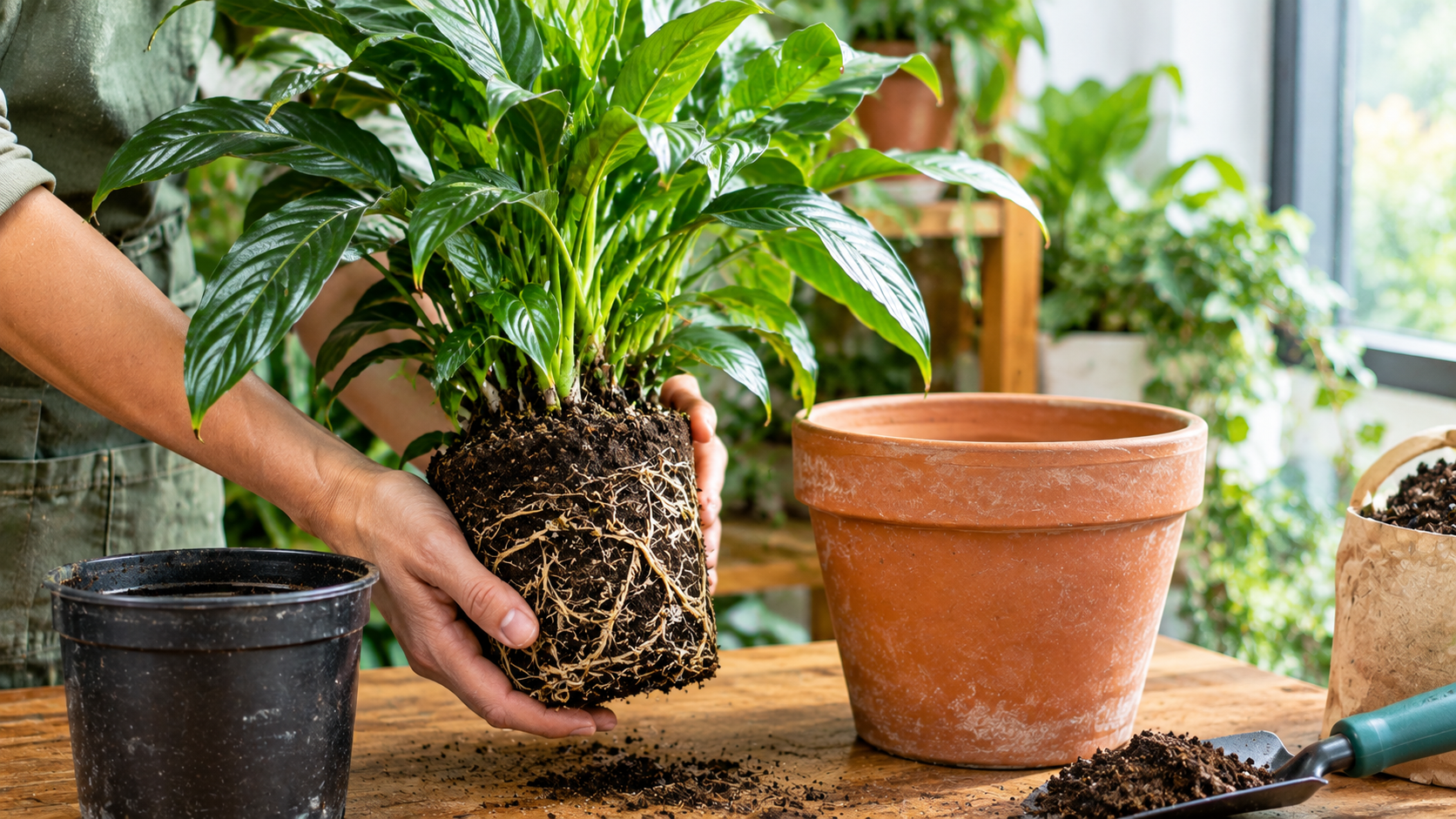
The most direct way to assess root space is to inspect the root ball. If the plant can be removed safely, slide it out of its pot while supporting the base of the plant and the soil.
Signs of crowding include:
- Roots forming a dense network around the sides or bottom of the root ball.
- Numerous roots circling around the inside of the container.
- A root ball that retains the shape of the pot and contains relatively little visible growing medium.
- Roots emerging from drainage holes, particularly when combined with restricted growth or rapid drying.
A few roots appearing through drainage holes do not automatically mean the plant urgently needs repotting. Check the overall root density and the plant’s condition before deciding.
The plant dries out unusually quickly
If a plant that previously stayed moist for several days now dries out much faster, its roots may be occupying much of the available space.
However, rapid drying can also result from hotter weather, stronger sunlight, low humidity, a porous terracotta pot, or a very free-draining potting mix. Check these conditions before assuming the container is too small.
Growth has slowed despite suitable care
A crowded root system can restrict further growth. If the plant receives appropriate light, water, and nutrients but remains unusually stagnant, inspect its roots and growing medium.
Slow growth alone is not proof of a pot-size problem. Some plants naturally grow slowly, particularly during periods of low light or cooler temperatures.
The plant has become unstable
A tall plant with a small root ball may wobble or tip easily. A larger, heavier pot may provide better support, especially for top-heavy foliage.
Still, instability can also indicate weak roots, an uneven root ball, or a container shape that is poorly suited to the plant. Choose a stable container that accommodates the roots rather than increasing the size without considering the plant’s needs.
How to Choose the Correct Pot Diameter
For many common houseplants, a useful starting point is to choose a new pot that is approximately 1–2 inches (2.5–5 cm) wider in diameter than the current container. This gives the roots room to expand without creating a disproportionately large volume of unused soil.
RHS Advice
+1
Measure the pot across its top opening, not around its circumference. If the current pot is 6 inches wide, for example, a pot around 7–8 inches wide may be appropriate, provided the root ball and plant’s needs support that change.
This is a guideline rather than a rule for every species or container. The Royal Horticultural Society advises that the new container should generally be no more than about one-third larger than the current one. The root ball, growth rate, and pot depth still matter.
RHS Advice
A practical pot-size guide
| Current pot diameter | Possible next size |
|---|---|
| 4 inches (10 cm) | 5–6 inches (12.5–15 cm) |
| 6 inches (15 cm) | 7–8 inches (17.5–20 cm) |
| 8 inches (20 cm) | 9–10 inches (22.5–25 cm) |
| 10 inches (25 cm) | 11–12 inches (27.5–30 cm) |
These examples are starting points for plants that genuinely need more room. Do not automatically move a plant into a larger pot simply because it has been growing for a certain number of months.
Choose Pot Depth According to the Root System
Diameter is important, but depth matters too. A pot can be wide enough and still be unsuitable if it does not provide enough room for the roots or retains excessive moisture beneath them.
Plants with relatively shallow roots
Some small plants, succulents, and alpine species grow well in relatively shallow containers. A shallow pot may also be easier to manage when the plant naturally has a compact root system.
However, shallow containers dry out quickly because they hold less growing medium. They may need more frequent moisture checks, especially in warm or sunny locations.
RHS Advice
Plants with deeper or more extensive roots
Plants with substantial root systems may need a deeper container, depending on the species. When repotting, choose a pot that accommodates the root ball without forcing the roots to bend sharply or leaving the plant sitting too deeply in the soil.
Avoid choosing a deep pot merely because the plant is tall. The height of the foliage does not always indicate the depth of the roots.
Check the shape, not just the measurements
A tall, narrow pot can be unstable for a top-heavy plant. A container that narrows sharply toward the opening can also make future repotting difficult because the root ball may become trapped.
For long-term growing, a pot with a practical shape and an opening wide enough to remove the plant is usually easier to maintain.
RHS Advice
Consider the Plant’s Growth Rate and Type
Different plants use their available root space at different rates. The right pot for a fast-growing foliage plant may not be the best choice for a slow-growing succulent or a compact flowering plant.
- Fast-growing foliage plants: Inspect the roots more regularly and repot when they become crowded. Do not jump several sizes ahead just to avoid future repotting.
- Slow-growing plants: Keep the pot close to the size of the root ball. Excess growing medium may stay wet for longer than the roots can use it.
- Cacti and succulents: Choose a container that fits the root system and use a growing medium suitable for the species. Drainage and appropriate drying periods remain important.
- Flowering plants: Consider the species’ root habits, expected mature size, and whether it performs best in a restricted or more spacious root environment.
- Large or top-heavy plants: Prioritize stability as well as root room. A heavier pot may be more useful than one that is simply much larger.
Species-specific requirements can override general pot-size guidelines. When you know the plant’s identity, consult a reliable growing guide before making a major change.
Avoid the Problem of Overpotting
Overpotting happens when a plant is placed in a container that is too large for its root system and growing conditions. A large pot is not automatically harmful, but it can become a problem when excess growing medium stays wet for too long.
The roots may occupy only a small central area while the surrounding soil remains damp. Poor aeration can then increase the risk of root damage, especially if the plant is watered frequently or growth is slow.
Potential warning signs include:
- Growing medium that stays soggy for an unusually long time.
- Yellowing or browning leaves.
- Leaf drop or wilting despite moist soil.
- Stunted growth.
- A plant that appears to decline after repotting.
These symptoms can have other causes, so do not diagnose overpotting from leaf color alone. Check drainage, watering habits, root condition, and the growing medium.
RHS Advice
If the pot is clearly oversized but the plant is otherwise stable, careful watering and monitoring may be enough. If the growing medium remains persistently wet and the plant is deteriorating, consider moving it into a more suitable container. Avoid repeatedly disturbing the roots without a clear reason.
Select a Pot with Proper Drainage
A pot’s size will not compensate for poor drainage. For most ordinary houseplants, choose a container with drainage holes so excess water can escape.
Without suitable drainage, water may collect around the roots and displace air from the growing medium. Roots need oxygen as well as water, so prolonged saturation can harm the plant.
Keep these points in mind:
- Check that drainage holes are open and not blocked by compacted soil.
- Use a potting mix appropriate for the plant rather than dense garden soil.
- Empty the saucer or decorative outer pot after watering.
- If you use a decorative cachepot without holes, keep the plant in a removable nursery pot with drainage.
Pot material also affects moisture. Unglazed terracotta loses water through its porous walls and usually dries faster than plastic. Plastic pots retain moisture longer, which can be useful in some conditions but requires careful watering.
RHS Advice
Step-by-Step: Repot a Plant into the Right Size
Once you have chosen a suitable container, repot carefully to reduce unnecessary stress.
Materials you may need:
- A clean pot with suitable drainage holes.
- Fresh potting mix appropriate for the plant.
- A small trowel or scoop.
- Gloves, if preferred.
- Clean pruning scissors only if damaged roots need attention.
Follow these steps
1. Inspect the existing pot. Check whether roots are crowded, the growing medium has deteriorated, or water is draining poorly.
2. Remove the plant gently. Support the root ball and avoid pulling forcefully on delicate stems. If the plant resists, loosen the growing medium around the edges or carefully work the container away.
3. Examine the roots. Healthy roots vary in color and texture by species. Look for dense circling roots, soft or decaying areas, and signs that the growing medium has broken down. Remove damaged roots only when necessary, using clean tools.
4. Prepare the new pot. Add enough fresh growing medium to position the top of the root ball just below the rim, leaving space for watering.
5. Position the plant. Set the root ball at approximately its previous planting depth. Avoid burying the stem base or piling extra mix over exposed stem tissue unless the species requires it.
6. Fill around the roots. Add fresh mix around the sides and gently settle it into gaps. Do not compress it so firmly that air spaces disappear.
7. Water and drain. Water appropriately for the species until the growing medium is evenly moistened and excess water exits through the drainage holes. Empty standing water afterward.
8. Monitor the plant. Place it in suitable light and avoid making several other major changes at once. Watch the moisture level and new growth over the following weeks.
Spring or the start of a plant’s active growth period is often a good time to repot, although the best timing depends on the species and local conditions.
RHS Advice
When You Can Keep the Same Pot
A plant does not always need a larger container when its roots become crowded. In some cases, refreshing the growing medium or carefully reducing the root ball may be appropriate.
This can be useful for established plants that are already in their desired container size, such as certain mature shrubs or plants grown in a controlled form. Root pruning is not suitable for every species, however, and removing too many roots can cause stress.
If the plant is healthy, has adequate drainage, and is growing well, there may be no reason to disturb it. If the growing medium has broken down, refreshing it may be more helpful than increasing the pot size.
RHS Advice
Frequently Asked Questions
Should I buy a pot that is much bigger so the plant can grow into it?
Usually, a modest increase is safer for common houseplants. A very large volume of unused growing medium may remain wet for too long, especially when the plant grows slowly or is watered frequently.
Do roots coming out of drainage holes mean I must repot immediately?
Not necessarily. Roots can emerge through drainage holes before the entire root system becomes crowded. Inspect the root ball and consider growth, watering frequency, and the condition of the growing medium.
Is a wider pot always better than a deeper one?
No. The appropriate shape depends on the root system and the species. Choose a container that accommodates the roots while maintaining good drainage and stability.
How often should I change the pot?
There is no universal schedule. Root growth, plant vigor, the condition of the growing medium, and the container’s size all influence when repotting is needed. Check the plant periodically rather than repotting automatically every year.
Choose for the Roots You Have, Not Just the Plant You See
The most reliable way to select a pot is to begin with the root ball, then consider the plant’s growth rate, the growing medium, drainage, and the conditions where it lives. For many houseplants, moving up by roughly 1–2 inches in diameter is a useful starting point, not a rigid rule.
A suitable pot should support future root growth without leaving an excessive amount of wet soil around the roots. When in doubt, inspect first, choose a moderate size increase, and monitor how the plant responds after repotting.