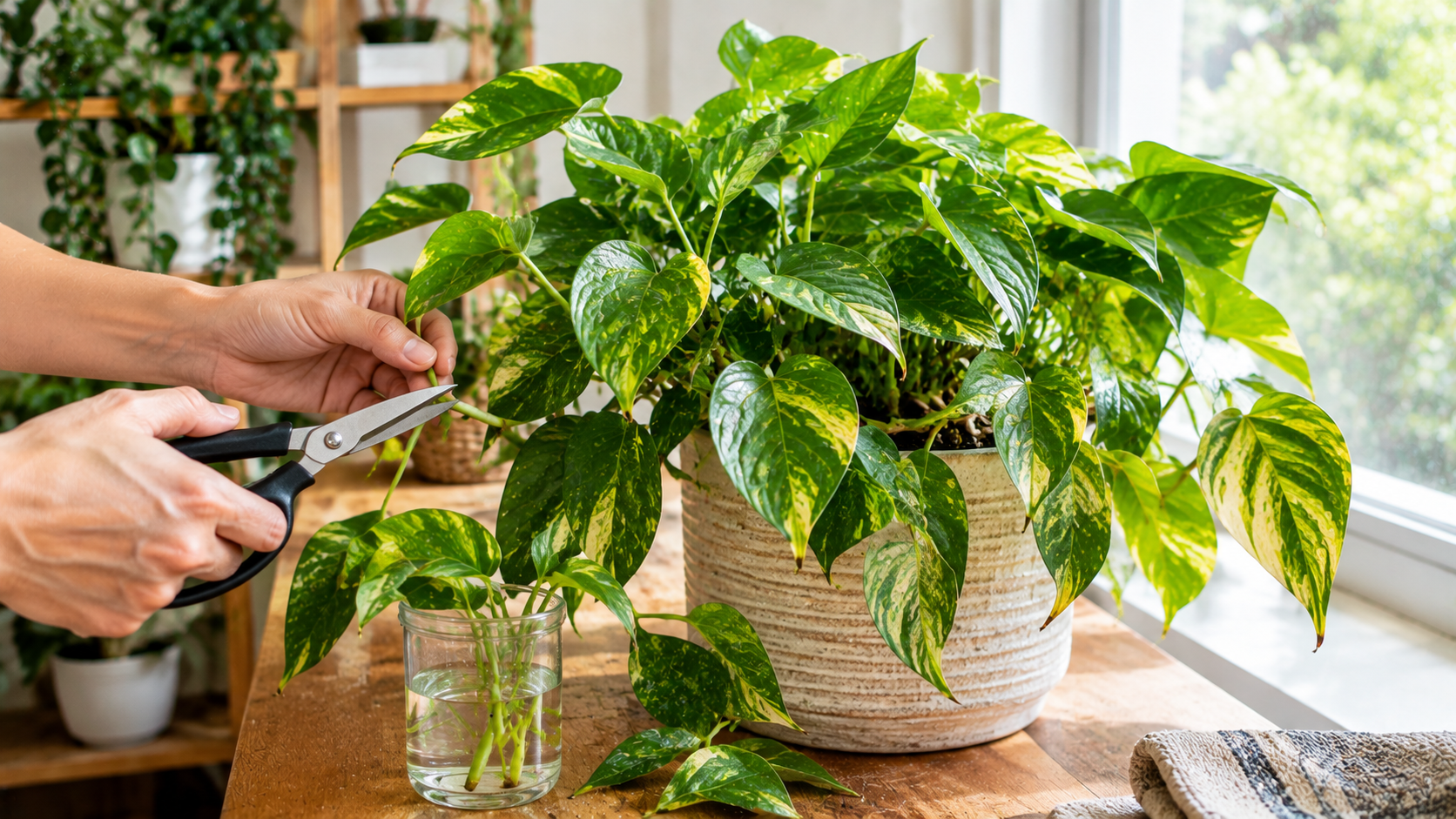
How to Care for a Pothos Plant Indoors and Encourage Fuller, Bushier Growth
A pothos plant can produce long, attractive vines yet still look sparse, with large gaps between leaves and a few stems hanging over the edge of the pot. If you want a fuller plant that looks lush from several angles, the solution is usually a combination of suitable light, thoughtful pruning, healthy roots, and strategic propagation.
Pothos (Epipremnum aureum) is popular because it adapts to many indoor environments and is relatively forgiving. However, tolerating low light or occasional neglect is not the same as growing at its best. When conditions are suitable, pothos can develop vigorous foliage and long trailing stems.
The key is to understand how the plant grows and encourage new shoots instead of simply allowing its existing vines to become longer. With a few practical adjustments, you can improve its shape while maintaining healthy growth.
Understand How Pothos Grows
Pothos is a climbing or trailing tropical plant. Its stems produce leaves at nodes, which are the points where leaves attach to the stem. These nodes can also develop aerial roots that help the plant attach to a support.
When a stem grows for a long time without being pruned, it may extend far beyond the pot while producing leaves separated by noticeable gaps. This is particularly common when the plant receives insufficient light.
A fuller appearance usually comes from encouraging more growth points and arranging healthy stems throughout the container. Simply providing more water or fertilizer will not necessarily make a sparse plant bushier.
It is also useful to distinguish between two goals:
- A fuller plant: More leafy stems and shoots are visible around the pot.
- Longer vines: Existing stems continue extending outward or downward.
These goals overlap, but they are not identical. Pruning and adding rooted cuttings can help increase fullness, while suitable light supports the development of healthy leaves and new growth.
Provide the Right Light for Dense Foliage
Light is one of the most important factors in pothos care. The plant can survive in relatively dim conditions, but deep shade often results in slower growth, longer gaps between leaves, and reduced variegation in varieties with yellow or white markings.
RHS
+1
Choose bright, indirect light
A location near an east-facing window or a bright window filtered by a sheer curtain can work well. The goal is to provide plenty of natural light without exposing the foliage to prolonged, intense direct sunlight that may scorch it.
If your pothos is growing in a dark corner, move it gradually to a brighter position. Observe the leaves over the following weeks rather than expecting an immediate transformation.
Rotate the pot occasionally so that different sides receive light. This can help prevent the plant from leaning strongly toward a single window.
Recognize signs of insufficient light
Your pothos may need a brighter location if you notice:
- Long stretches of stem between leaves.
- Slow or weak new growth.
- Reduced yellow or cream markings on a variegated variety.
- Most foliage developing on one side of the plant.
These signs are not exclusive to low light, so also consider the plant’s watering, root condition, and general health.
More light can support fuller growth, but excessive direct sun can damage leaves. Increase light gradually and assess the response.
Water Correctly to Support Healthy Roots
Pothos does not need constantly wet soil. Its roots require both moisture and oxygen, so keeping the growing medium saturated can cause root damage and interfere with healthy growth.
Check the soil before watering. The Royal Horticultural Society recommends allowing the upper portion of the growing medium to dry between waterings. For many established indoor pothos plants, checking approximately the top inch (2–3 cm) is a useful starting point, although pot size, temperature, and soil composition affect how quickly it dries.
RHS
+1
When watering is needed:
- Apply water evenly across the growing medium.
- Continue until excess water drains through the bottom.
- Empty the saucer or decorative outer pot.
- Wait until the appropriate portion of the soil dries before watering again.
Do not follow a fixed weekly schedule without checking the soil. A plant in a warm, bright room may dry more quickly than one in a cool, dim location.
If the leaves turn yellow or the plant wilts while the soil remains wet, investigate drainage and root health rather than adding more water. Healthy roots are essential for sustained new growth.
Choose a Suitable Pot and Potting Mix
A pot that is much larger than the root ball may retain more moisture than the plant can use. On the other hand, a severely crowded root system can make watering difficult and restrict further development.
Choose a container with drainage holes that gives the roots room to expand without leaving a disproportionately large volume of wet growing medium around them.
A good-quality indoor potting mix that drains well is generally suitable. Avoid dense garden soil in containers because it may compact and drain poorly under indoor conditions.
Repot when the roots are crowded, the growing medium has deteriorated, or water management has become difficult. Do not assume that moving a pothos into a much larger pot will automatically produce larger leaves or more branches.
Prune Long Vines to Encourage a Fuller Appearance
Pruning is one of the most useful ways to reshape a pothos. It shortens excessively long stems and can encourage new shoots to develop from nodes below the cut.
For best results, use clean, sharp scissors or pruning shears. Spring and summer are often convenient times because the plant is actively growing, although timing depends on the indoor environment.
How to prune a sparse pothos
- Inspect the stems. Identify long vines with large gaps between leaves, as well as damaged or weak sections.
- Choose where to cut. Make a clean cut just above a healthy node on the portion of stem you want to keep.
- Shorten gradually. If the plant is very sparse, avoid removing a large amount of foliage all at once. Several smaller adjustments can be easier for the plant to recover from.
- Keep healthy cuttings. Stems with suitable nodes can be used to grow additional plants.
- Provide suitable aftercare. Keep the plant in good indirect light and water according to soil moisture rather than increasing watering automatically after pruning.
A node is important because it contains the point from which new growth can develop. Cutting a stem indiscriminately in the middle of a section without a suitable node may not produce the outcome you expect.
Pruning does not guarantee that every cut will produce multiple shoots. The plant’s health, light, and growth stage influence the response. Penn State Extension also describes shortening pothos vines as a way to keep the plant compact and bushy.
Penn State Extension
Propagate Cuttings to Fill Empty Areas in the Pot
A plant can remain sparse even after pruning because it has only a few established stems emerging from the root system. One practical solution is to propagate healthy cuttings and plant the rooted pieces back into the same container.
This increases the number of individual stems in the pot and can create a fuller appearance more quickly than waiting for the original plant to fill every gap.
How to prepare pothos cuttings
Each cutting needs at least one suitable node. A leaf without a node will not normally develop into a new vine because it lacks the necessary growing point.
Follow these steps:
- Select a healthy stem and identify its nodes.
- Cut a section containing at least one node and, preferably, an attached healthy leaf.
- Place the node in water or a suitable propagation medium. If using water, keep the leaf above the surface.
- Position the cutting in warm conditions with bright, indirect light.
- Check regularly for root development and replace water when it becomes cloudy.
- Once the roots are sufficiently developed for planting, transfer the cutting to a suitable potting mix and keep the medium appropriately moist while it establishes.
Rooting time varies with temperature, light, and cutting condition. The University of Wisconsin–Madison Extension notes that pothos can be propagated from stem cuttings and that planting several rooted cuttings together is an effective way to create a fuller container.
Wisconsin Horticulture
Plant rooted cuttings around the pot
To improve the overall shape, distribute rooted cuttings around open areas rather than placing all of them in one cluster.
Make a small hole in the growing medium, position the roots carefully, and cover them without burying the leaves. Water as appropriate for the soil and allow excess moisture to drain.
Do not overcrowd the pot excessively. Too many stems competing in a small container can make it harder to manage moisture and airflow. The aim is a balanced arrangement of healthy plants, not the maximum possible number of cuttings.
Use a Support if You Prefer Upward Growth
Pothos can trail from a hanging basket or shelf, but it can also climb a suitable support. A moss or coir pole gives the stems a surface to attach to using their aerial roots.
RHS
+1
Choose the growing style that suits your space:
- Trailing: Allow the stems to hang naturally from a shelf or hanging planter.
- Compact and bushy: Prune long vines and add rooted cuttings to empty areas.
- Climbing: Guide the stems gently along a stable support and secure them loosely where needed.
A support changes the plant’s shape, but it does not replace the need for adequate light and healthy roots. If the plant is already sparse, improve its growing conditions before expecting a pole to produce fuller foliage.
Fertilize Without Overdoing It
Nutrients support new leaves and stems, but excessive fertilizer can damage roots and create salt buildup in the growing medium.
During active growth, a balanced houseplant fertilizer used according to its label can support development. The Royal Horticultural Society recommends feeding pothos during the growing season.
RHS
Avoid increasing the dose simply because the plant looks thin. Sparse growth is often related to light, pruning, or the number of stems in the pot rather than a nutrient deficiency.
If the plant has recently been repotted into fresh potting mix, check whether that mix already contains fertilizer before adding more. During periods of slow growth, reduce feeding according to the product instructions and the plant’s condition.
Common Mistakes That Prevent Fuller Growth
Some well-intentioned habits can work against your goal.
- Keeping the plant in deep shade: Pothos may survive, but growth can become sparse and slow.
- Watering too frequently: Constantly wet soil can damage roots and weaken new growth.
- Pruning without keeping usable nodes: Cuttings need nodes to develop into new plants.
- Expecting fertilizer to solve every problem: Nutrients cannot compensate for poor light or damaged roots.
- Adding cuttings before checking the existing plant: If the original roots are unhealthy, improve their condition before increasing the number of stems in the pot.
- Pruning too aggressively: Removing too much foliage at once can place additional stress on a weak plant.
Pothos is also toxic if eaten and may irritate the mouth and digestive tract. Keep it away from children and pets who might chew the leaves, and wash your hands after handling plant sap.
Penn State Extension
+1
Frequently Asked Questions
How long does it take for pothos to become bushier?
The timeline varies with light, temperature, plant health, and the time of year. Pruning may encourage new shoots, while rooted cuttings add stems after they establish. Look for gradual changes over several weeks rather than expecting an instant transformation.
Can I cut off all the long vines?
It is usually better to prune gradually, especially if the plant is weak or has limited foliage. Keep healthy sections with nodes for propagation, and avoid removing so much foliage that the plant loses most of its ability to support growth.
Why does my pothos have long stems but few leaves?
Insufficient light is a common cause, but it is not the only possibility. Check the plant’s location, root condition, watering habits, and general health. Improve the conditions first, then prune and propagate if you want a fuller shape.
Should I mist pothos to make it grow more leaves?
Regular misting is not a reliable way to make pothos bushier. Focus instead on suitable light, appropriate watering, healthy roots, and strategic pruning.
Build a Fuller Pothos One Step at a Time
For a lush pothos, start by placing it in bright, indirect light and checking that its soil drains well. Once the plant is growing under suitable conditions, shorten overly long vines and use healthy, node-bearing cuttings to fill empty areas around the pot.
Avoid changing everything at once. Give the plant time to respond, watch for new shoots, and adjust care according to what you observe. With consistent attention to light, moisture, and pruning, you can encourage a healthier plant with a fuller, more balanced appearance.