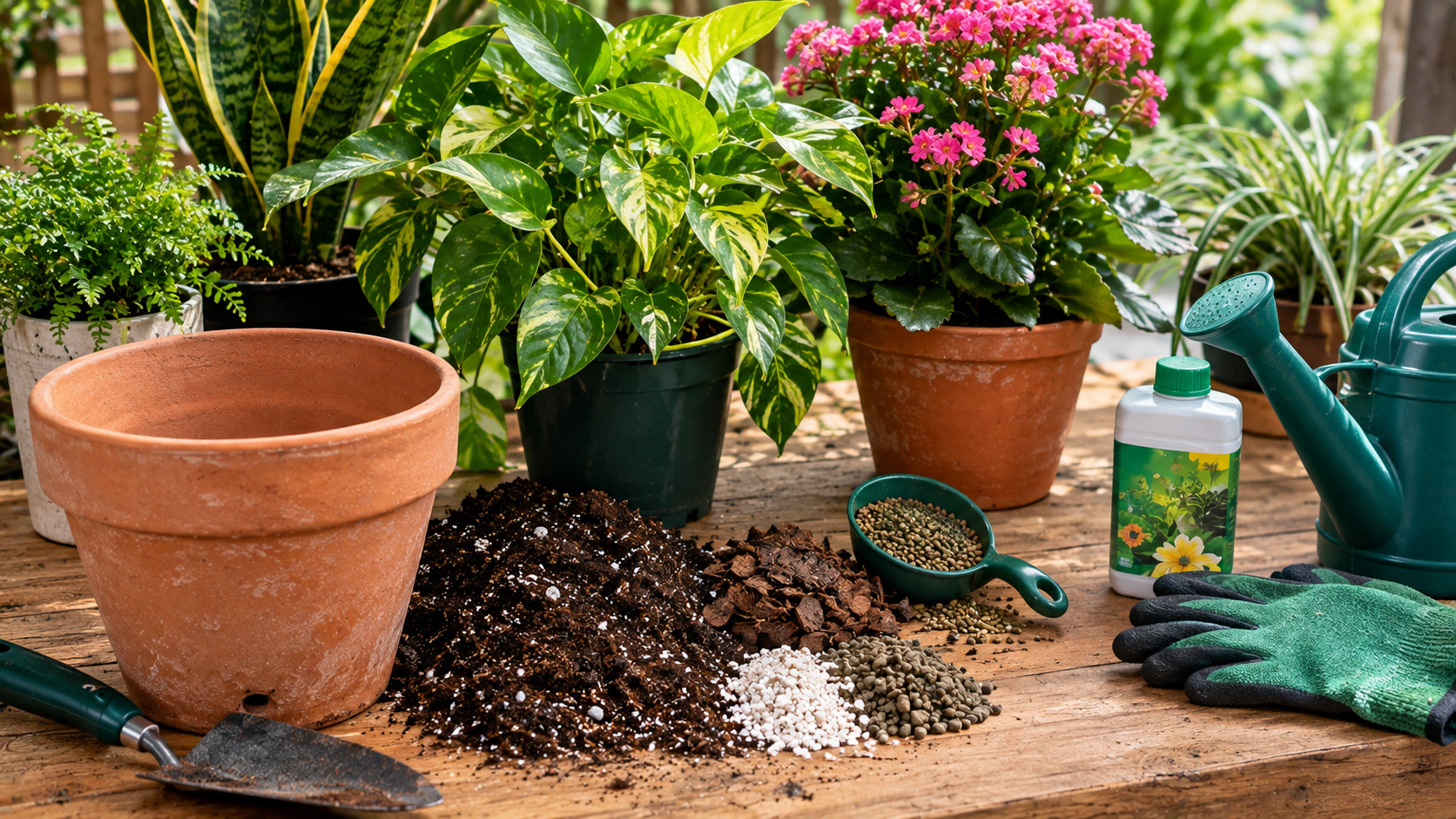
Choosing the right pot, using a suitable potting mix, providing nutrients, and maintaining a consistent care routine can make a significant difference to the health of houseplants. Yet these tasks are often misunderstood. A plant with yellow leaves, slow growth, or wilting may not need more water or fertilizer; it may have compacted potting mix, damaged roots, or a container that holds too much moisture.
The key is to treat these elements as parts of the same growing system. The pot controls drainage and root space, the potting mix balances water and air, fertilizer supplies nutrients, and regular maintenance helps you notice problems before they become serious. Understanding how these factors work together makes plant care more predictable and helps avoid unnecessary changes.
How to Choose the Right Pot for Your Plant
A good container provides enough room for roots, allows excess water to escape, and suits the plant’s growth habits. Appearance matters, but practical features should come first.
Why drainage holes matter
For most houseplants grown in potting mix, a pot with drainage holes is essential. Water that remains around the roots displaces air from the mix, making it harder for roots to function and increasing the risk of rot.
Decorative containers without holes can still be used as outer covers. Keep the plant in a separate nursery pot with drainage, remove it for watering, and let it drain completely before returning it to the decorative container. Never leave standing water at the bottom.
Adding gravel or stones to the bottom of a pot does not replace drainage holes. The more reliable solution is to use a container that lets excess water escape freely.
Pot size and material
Choose a pot that fits the existing root system rather than one that looks impressively large. When repotting, a container only modestly wider than the previous one is usually safer than a much larger pot. Excess potting mix can remain wet for too long when roots cannot use the moisture quickly.
Different materials also affect care:
- Terracotta: Porous walls allow moisture to evaporate more readily. It suits many succulents and plants that prefer the mix to dry between waterings, although it may require more frequent watering.
- Plastic: Retains moisture longer and is relatively lightweight. It can work well for tropical plants, provided drainage and watering are managed carefully.
- Glazed ceramic: Usually loses less moisture through its walls than unglazed terracotta. Check whether the pot has drainage holes.
- Hanging baskets: Need secure supports, suitable liners, and enough drainage to prevent water from collecting around roots.
A practical example: a small succulent in a large plastic pot may stay wet too long, while a vigorous tropical plant in a small terracotta pot may dry out rapidly. The best choice depends on the plant, the potting mix, the light, and the room temperature.
How to Select the Best Potting Mix
Potting mix is not simply soil used to fill a container. It must support roots, retain enough moisture for the plant to absorb, and maintain air spaces so roots can function properly.
Garden soil taken directly from the ground is often unsuitable for indoor containers because it can become dense, drain poorly, or introduce weeds and pests. Use a quality potting mix formulated for container growing instead.
Match the mix to the plant
Different plants need different balances of moisture retention and aeration.
- Tropical foliage plants, such as pothos and philodendrons, generally benefit from a mix that retains some moisture while allowing excess water to drain.
- Cacti and succulents usually need a more free-draining mix with mineral components such as perlite, pumice, or horticultural grit.
- Orchids that grow naturally on trees commonly require a coarse, airy medium such as specialized orchid bark rather than ordinary dense potting soil.
- Ferns and other moisture-loving plants often prefer a mix that stays evenly moist without becoming waterlogged.
- Acid-loving plants, such as certain azaleas, need a growing medium with an appropriate acidic pH.
Read the product label and check whether the mix already contains fertilizer. Some products provide nutrients for an initial period, so adding more immediately may be unnecessary.
What common potting mix ingredients do
| Ingredient | Main purpose |
|---|---|
| Coir or peat-free organic fibers | Help retain moisture |
| Composted bark | Adds structure and air spaces |
| Perlite or pumice | Improves aeration and drainage |
| Horticultural grit | Adds mineral structure to suitable mixes |
| Compost | Contributes organic matter and, depending on the product, nutrients |
There is no single recipe that works for every plant. If a mix dries out too quickly, it may need more moisture-retaining material. If it remains saturated for days, a more open mix or a change in watering may be necessary.
When and How to Repot a Houseplant
Repotting gives roots more room and replaces potting mix that has broken down over time. However, repotting is not automatically the solution to every growth problem.
Signs that repotting may be needed
Look for several clues rather than relying on one symptom:
- Roots emerging from drainage holes or densely circling the root ball.
- Water running through very quickly because little mix remains.
- Potting mix that has become compacted and stays excessively wet.
- Growth that has slowed despite suitable light, temperature, and watering.
- A container that has become unstable or is visibly too small for the plant.
Some roots coming out of drainage holes do not always mean immediate repotting is necessary. Check the overall root system and how quickly the plant dries out.
A careful repotting procedure
- Prepare the new pot. Select one with drainage holes and only a modest increase in diameter.
- Check the root ball. Slide the plant out gently. Healthy roots are generally firm; dark, soft, or foul-smelling roots may indicate rot.
- Remove loose, exhausted mix. Avoid tearing apart healthy roots unnecessarily. Remove damaged roots with clean tools if needed.
- Add fresh potting mix. Position the plant at approximately its previous depth. Burying the stem deeper than before can encourage rot in some species.
- Fill around the roots. Add mix gently, leaving enough room at the top for watering. Do not compress it so firmly that air spaces disappear.
- Water according to the plant’s needs. For most plants, water thoroughly and allow excess to drain. Plants that prefer very dry conditions need an approach suited to their particular requirements.
- Provide appropriate aftercare. Keep the plant in suitable light and avoid immediately adding extra fertilizer unless the product and plant instructions indicate it is appropriate.
Repotting is often easiest during active growth, commonly in spring or early summer for many houseplants. Nevertheless, a plant with serious root problems may need attention regardless of season.
Fertilizing Houseplants Without Overfeeding Them
Plants need nutrients to develop leaves, stems, roots, and flowers. In containers, however, the available supply is limited, and nutrients may gradually be used by the plant or washed out during watering. Fertilizer can help, but applying more than necessary can damage roots and cause salt buildup.
Understanding fertilizer labels
Many fertilizers list three main nutrients as N-P-K:
- Nitrogen (N): Supports leafy growth.
- Phosphorus (P): Plays a role in root development and energy transfer.
- Potassium (K): Supports several plant functions, including water regulation and overall development.
A higher number does not automatically mean a better fertilizer. Choose a product suitable for the plant group and follow the label rather than selecting one based on a single nutrient.
Foliage plants, flowering plants, orchids, cacti, and edible plants may have different requirements. A general-purpose houseplant fertilizer is a reasonable starting point for many foliage plants, while specialized plants may need a product formulated for their growing medium and nutrient needs.
Liquid fertilizer or slow-release granules?
Liquid fertilizer is easy to measure and adjust, making it useful when a plant is actively growing. Slow-release granules supply nutrients over a longer period, but their release rate depends on the product and environmental conditions.
Before applying either type:
- Check whether the potting mix already contains fertilizer.
- Read the label for dosage, frequency, and plant suitability.
- Apply fertilizer to appropriately moist potting mix if the product instructions permit it; avoid concentrating fertilizer around dry, stressed roots.
- Reduce or pause feeding when growth slows, unless the species has different requirements.
- Do not combine several fertilizer products without understanding their total nutrient contribution.
More fertilizer will not compensate for inadequate light, poor drainage, or damaged roots. If leaves are yellowing, investigate watering, root health, light, pests, and nutrient availability before assuming a deficiency. Fertilizer burn and root damage can also produce discolored leaves.
A Simple Maintenance Routine That Prevents Problems
Regular observation is more useful than making frequent changes. A short weekly inspection helps you identify changes while giving the plant time to respond to care.
Water according to moisture, not the calendar
There is no universal watering schedule for all houseplants. A small terracotta pot in a sunny room may dry much faster than a large plastic pot in a cool corner.
Before watering, check the moisture below the surface with a finger or suitable moisture meter. Lift the pot occasionally to learn how its weight changes as the mix dries. Water thoroughly when appropriate for the species, then let excess water drain away.
Succulents generally need more drying time than many tropical foliage plants. Ferns may prefer more consistent moisture, but their roots still need air. Adjust the interval according to the plant, season, light, temperature, and potting mix.
Clean leaves and inspect for pests
Dust can accumulate on foliage and reduce its appearance. Wipe broad leaves gently with a soft, damp cloth, supporting each leaf as needed. Avoid household cleaning products or leaf-shine products unless specifically recommended for the plant.
During inspection, look underneath leaves and around stems for fine webbing, sticky residue, cotton-like clusters, scale insects, or small flying insects. Isolate plants with suspected pests to reduce the chance of spread. Identify the pest before choosing a treatment, and follow the product label and local guidance if a treatment is needed.
Remove dead leaves and spent flowers with clean tools. Do not remove large amounts of healthy foliage simply to make a plant look tidy; green leaves still help supply energy for growth.
Keep a simple care record
A basic record can reveal patterns that are difficult to notice day by day. Note the date of watering, whether the potting mix was dry or moist, fertilizer applications, repotting, and any unusual symptoms.
For example, if a plant repeatedly develops yellow leaves while its pot remains wet for several days, check drainage and root condition before increasing fertilizer. If a plant dries out unusually quickly and its roots densely fill the pot, it may need fresh mix or a slightly larger container.
Common Mistakes With Pots, Potting Mix, and Fertilizer
Small mistakes can create problems that appear to be unrelated. These are among the most common:
- Choosing a pot that is too large: The unused mix may remain wet for too long. Move up gradually in size.
- Using a container without drainage: Excess water can collect around the roots. Use a nursery pot with holes or an appropriate container designed for planting.
- Using the same mix for every plant: A moisture-loving fern and a drought-tolerant succulent have different needs. Match the mix to the species.
- Fertilizing a stressed plant automatically: Root damage, low light, and watering problems can mimic nutrient deficiency. Investigate first.
- Changing several conditions at once: If you repot, relocate, increase fertilizer, and change watering simultaneously, it becomes difficult to identify what helped or harmed the plant.
- Ignoring seasonal changes: Indoor light and growth rates can change throughout the year. Reassess watering and feeding rather than following the same routine indefinitely.
If a plant deteriorates rapidly, inspect its roots and growing conditions before making multiple interventions. A severely waterlogged plant may need a fresh, airy mix, while a healthy plant with a few older yellow leaves may need no major change at all.
Frequently Asked Questions
How often should I repot houseplants?
There is no fixed interval for every species. Many houseplants benefit from fresh potting mix or repotting every few years, but the root system, mix condition, and plant growth are better guides than the calendar alone.
Can I reuse old potting mix?
It is usually safer to use fresh mix for a new plant, particularly if the previous plant had root rot, pests, or disease. Old mix may have a degraded structure or depleted nutrients. If reusing material for an appropriate purpose, first assess its condition and avoid transferring known pests or pathogens.
Should I fertilize every time I water?
Not necessarily. Some products are designed for frequent dilute application, while others are intended for less frequent use. Follow the specific label and account for any fertilizer already present in the mix.
Why are my plant’s leaves yellow even though I fertilize it?
Yellow leaves can result from excess water, poor drainage, insufficient light, damaged roots, pests, or nutrient problems. Check the growing conditions and look for a pattern before applying more fertilizer.
Build a Routine Around What Your Plants Show You
Healthy container plants depend on the balance between root space, an appropriate potting mix, careful feeding, and consistent maintenance. Start by checking drainage and moisture, choose a growing medium suited to the species, and fertilize only when it is appropriate.
Make one change at a time whenever possible, then observe new growth and the condition of the leaves over the following weeks. This measured approach helps you distinguish a genuine problem from normal changes in growth and makes long-term plant care easier.