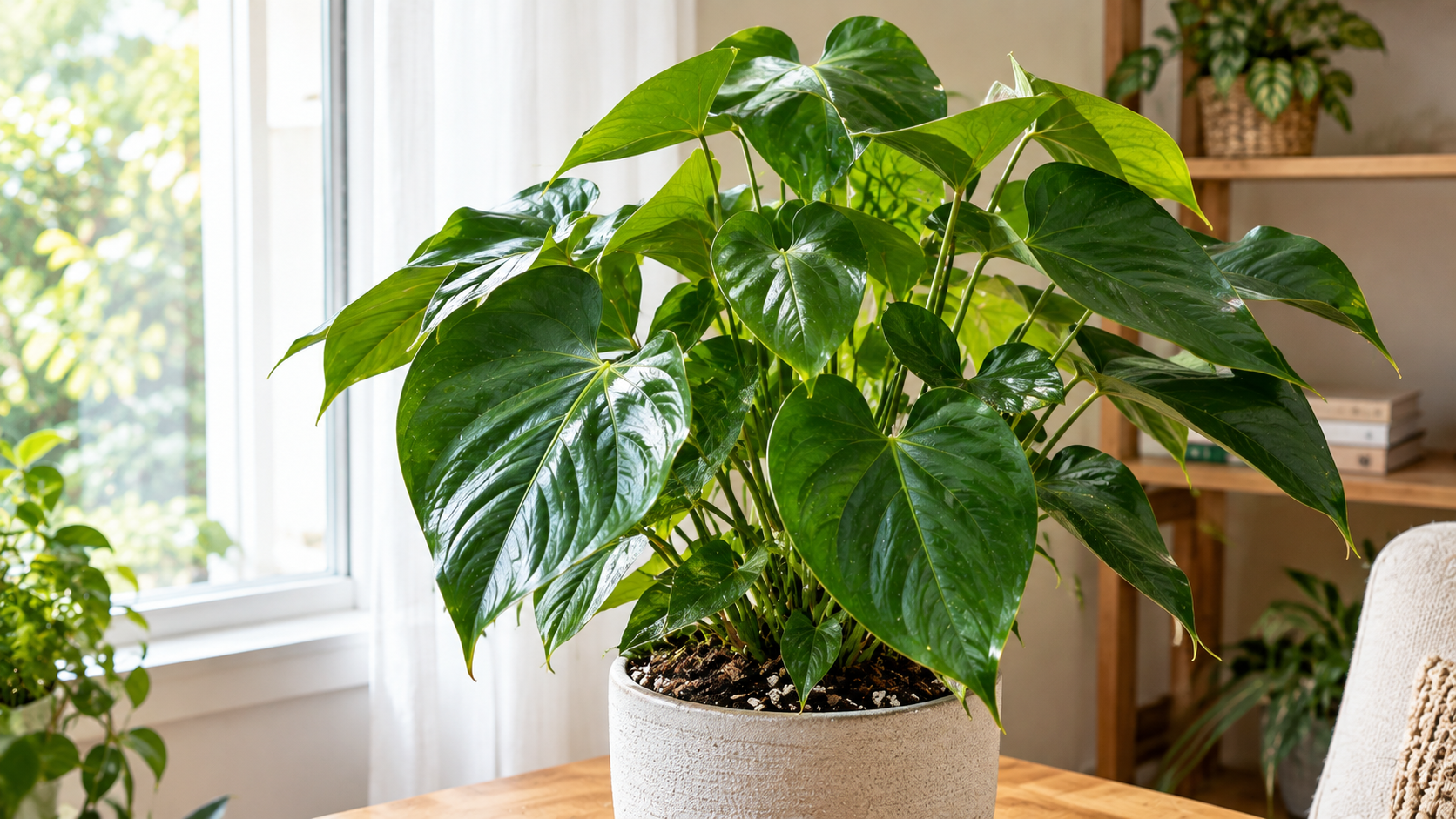
An anthurium can produce large, glossy green leaves and still refuse to bloom. If your plant looks healthy but has not produced its familiar red, pink, or white flower-like structures, the problem may be its growing conditions rather than a disease.
The first place to investigate is usually the light. Anthuriums need enough indirect light to support flowering, but other factors—including watering, root health, temperature, humidity, and fertilizer—can also affect their performance. Changing everything at once makes it difficult to identify the real cause.
By checking each condition in a logical order, you can improve the environment gradually and give your anthurium a better chance of producing new blooms.
Understand Why an Anthurium Can Grow Leaves Without Flowers
The colorful part commonly called the anthurium flower is technically a spathe, a modified leaf surrounding a central structure called the spadix. The tiny true flowers are arranged along that central spike.
For the common flowering anthurium (Anthurium andraeanum), attractive foliage does not necessarily mean the plant receives enough energy to flower. North Carolina State University Extension identifies insufficient light as a cause of reduced flowering and slower growth. The University of Florida’s horticultural guidance also lists low light as a likely explanation when a plant produces many leaves but few or no flowers.
Before changing the care routine, consider the plant’s recent history. Was it recently purchased, moved to another room, repotted, or exposed to cooler conditions? A change in environment can interrupt growth, and a plant that has finished a flowering period may need time to produce new blooms.
1. Check Whether the Anthurium Receives Enough Light

Insufficient light is one of the first conditions to investigate when an anthurium grows leaves but does not flower. A dim corner may be adequate for the plant to survive for a while, yet still provide too little energy for consistent flowering.
How to recognize a light problem
Look at where the plant sits during the day. If it is far from a window, shaded by curtains, or surrounded by walls that block daylight, its light exposure may be inadequate. Healthy-looking green leaves do not rule out this possibility.
On the other hand, brown or bleached patches may indicate excessive direct sunlight. Anthuriums generally prefer bright, indirect light: the goal is to provide a bright environment without exposing the foliage to harsh sun that can scorch it.
How to improve the light safely
- Move the plant gradually toward a brighter window, where daylight reaches it without strong direct sun on the leaves.
- Observe the area at different times of day, since morning and afternoon sunlight can differ considerably.
- If natural light is limited, consider a suitable grow light and follow the manufacturer’s recommended distance and operating schedule.
- Watch for leaf discoloration after moving the plant. If scorching appears, reduce direct exposure.
Do not move the anthurium into intense sunlight simply to encourage flowers. More light is helpful only when it remains within the plant’s tolerance.
2. Review Watering and Root Health
Anthuriums need moisture, but their roots also require oxygen. A potting mix that remains saturated for long periods can damage roots, making it harder for the plant to absorb water and nutrients properly.
The opposite problem can also occur. Allowing the root ball to dry out completely and repeatedly may stress the plant, especially in a warm room or a small pot.
What to inspect before watering
Check the upper layer of the potting mix with a finger. If it still feels wet, wait before watering again. Also lift the pot, when practical, to assess whether it feels unusually heavy from retained water.
Look for warning signs such as yellowing older leaves, a persistently wet mix, an unpleasant smell, or soft, dark roots if the root system is examined. These signs can suggest excessive moisture or root damage, although no single symptom proves the cause.
A better watering routine
Water when the upper layer of the mix has begun to dry, adjusting the interval to the room’s temperature, light, pot size, and growing medium. Water thoroughly enough to moisten the root zone, then allow excess water to drain through the pot’s drainage holes.
Never leave the container standing in a full saucer. If the mix stays wet for too long despite careful watering, examine its structure and drainage rather than simply reducing water indefinitely. Anthuriums benefit from a moist but well-drained growing medium.
3. Check the Potting Mix and Container
A plant can have beautiful foliage but struggle to flower if its roots are growing in compacted, poorly aerated soil. Anthuriums are tropical plants that often grow naturally on or around other vegetation, so their roots benefit from a growing medium that retains some moisture while allowing air to circulate.
Ordinary garden soil can become too dense in a container, particularly after repeated watering. A mix designed for indoor tropical plants, with suitable organic material and coarse components, can provide a better balance between moisture retention and drainage.
When should you consider repotting?
Repotting may be appropriate if water runs through the pot without wetting the mix evenly, the medium stays saturated for an unusually long time, or roots are crowded and drainage is poor. It is not automatically necessary just because the plant is not flowering.
Choose a pot with drainage holes and only a modest increase in size if the existing container is genuinely too small. A container that is much larger than the root system can hold excess moisture for longer, increasing the risk of root problems.
If the roots look healthy and the mix drains properly, avoid repotting solely to trigger flowering. Repotting itself can cause temporary stress, so make changes only when there is a clear reason.
4. Maintain Suitable Temperature and Humidity
Anthuriums come from tropical regions and generally grow best in warm, humid conditions. Cold drafts, sudden temperature changes, and dry indoor air can interfere with their overall performance, even when the leaves initially appear attractive.
The Royal Horticultural Society recommends growing Anthurium andraeanum in bright, indirect light, high humidity, and temperatures above 18°C for cultivation. North Carolina State University Extension gives a preferred temperature range of approximately 18–29°C for anthuriums. These are useful guides, although the ideal conditions can vary by species and cultivar.
How to assess your room
- Cold windowsills: Glass can become cold at night. Keep the plant away from cold drafts and sudden temperature fluctuations.
- Air-conditioning or heating vents: Direct airflow can dry the foliage and create uncomfortable temperature changes.
- Very dry rooms: Brown leaf tips may indicate low humidity, although watering problems and mineral buildup can produce similar symptoms.
If the air is dry, a room humidifier can help raise humidity around the plant. Grouping plants together may also create a slightly more humid local environment, although the effect depends on room conditions.
Do not rely on frequent misting as the only solution. Misting usually raises humidity for only a short time and may leave the foliage wet without meaningfully improving the room’s overall humidity.
5. Review Fertilizer Before Adding More
When an anthurium refuses to bloom, it is tempting to reach for a fertilizer advertised for flowering plants. However, more fertilizer does not necessarily mean more flowers.
Excess fertilizer can cause soluble salts to accumulate in the potting mix and damage roots. Too much nitrogen may also encourage leafy growth without addressing the conditions limiting flowering.
The University of Florida’s guidance for commercial anthurium production describes the importance of balanced nutrition and monitoring the growing medium. Those production recommendations are not a direct household dosing schedule, but they support a practical principle: nutrition must be appropriate to the plant’s needs, not increased indiscriminately.
How to fertilize more carefully
- Check the fertilizer label and determine whether you have been feeding the plant regularly.
- If the plant is actively growing and its roots appear healthy, use a fertilizer suitable for flowering tropical houseplants.
- Follow the label’s dilution and frequency instructions. Do not combine multiple products in an attempt to accelerate blooming.
- If leaf tips are browning or a crust has formed on the mix, consider whether fertilizer salts or water quality may be contributing to the problem.
A fertilizer marketed as high in phosphorus is not a substitute for adequate light, healthy roots, and suitable growing conditions. Correct the limiting factor first, then maintain a moderate feeding routine during active growth.
6. Consider the Plant’s Age, Variety, and Recent Changes
Not every anthurium flowers at the same rate. The genus contains many species, including plants grown mainly for their ornamental foliage. Some anthuriums have large, colorful spathes, while others are valued for distinctive leaf shapes and patterns.
If your plant has never flowered at home, it may be a foliage-focused species, a young plant, or a variety that needs different conditions from the common florist anthurium. Identifying the plant can prevent you from trying to force flowering in a variety not commonly grown for showy blooms.
Recent changes also matter. A newly purchased plant may have been grown under controlled nursery conditions that differ from your home. Moving it, dividing it, or repotting it can temporarily interrupt growth. Allow it to settle while maintaining consistent care rather than making several more changes immediately.
7. A Practical Checklist for Encouraging New Blooms
Use this order to investigate the most likely causes without overwhelming the plant with unnecessary adjustments.
- Check the light first. Move the anthurium to a brighter position with indirect light if it is in a dim corner.
- Inspect the potting mix. Confirm that it is not compacted or remaining saturated for extended periods.
- Assess watering. Water according to the moisture of the mix, not a fixed calendar.
- Review the room. Avoid cold drafts, abrupt temperature changes, and excessively dry conditions.
- Evaluate feeding. Correct underfeeding only if appropriate, and avoid excess fertilizer.
- Check for pests. Inspect both sides of leaves and the growing points for insects, webbing, or distorted new growth.
- Make changes gradually. Keep a brief record of the plant’s location, watering, and any care adjustments so you can see what changes over time.
Give the plant time to respond. Existing leaves will not necessarily change immediately, and new flowers may take time to develop even after conditions improve.
Frequently Asked Questions
Can an anthurium have healthy leaves and still be unhealthy?
Yes. Glossy leaves are encouraging, but they do not prove that every growing condition is ideal. A plant may have enough resources to maintain its foliage while receiving insufficient light for flowering or experiencing early root stress.
Should I cut off leaves to encourage flowers?
Do not remove healthy leaves for this purpose. They help the plant capture light and support growth. Remove only dead or badly damaged foliage with clean tools, and avoid pruning simply because the plant is not blooming.
How long does it take an anthurium to flower again?
There is no guaranteed timetable. The time depends on the species or cultivar, maturity, growing conditions, and recent stress. Once the environment is suitable, continue consistent care and watch for new growth rather than expecting immediate flowers.
Is direct sunlight necessary for anthuriums to bloom?
No. Bright, indirect light is generally the safer choice for common flowering anthuriums grown indoors. Strong direct sunlight can scorch leaves, so improve brightness without exposing the plant to harsh sun.
Give Your Anthurium the Conditions It Needs to Bloom
When an anthurium has beautiful leaves but no flowers, begin by checking its light exposure and the condition of its roots. Then review watering, drainage, temperature, humidity, and fertilizer in that order, changing only what the evidence suggests is necessary.
Avoid trying to force flowering with excessive fertilizer, frequent repotting, or sudden changes in location. Consistent care and careful observation offer a more reliable path toward healthy growth and future blooms, even though flowering cannot be guaranteed on a specific schedule.