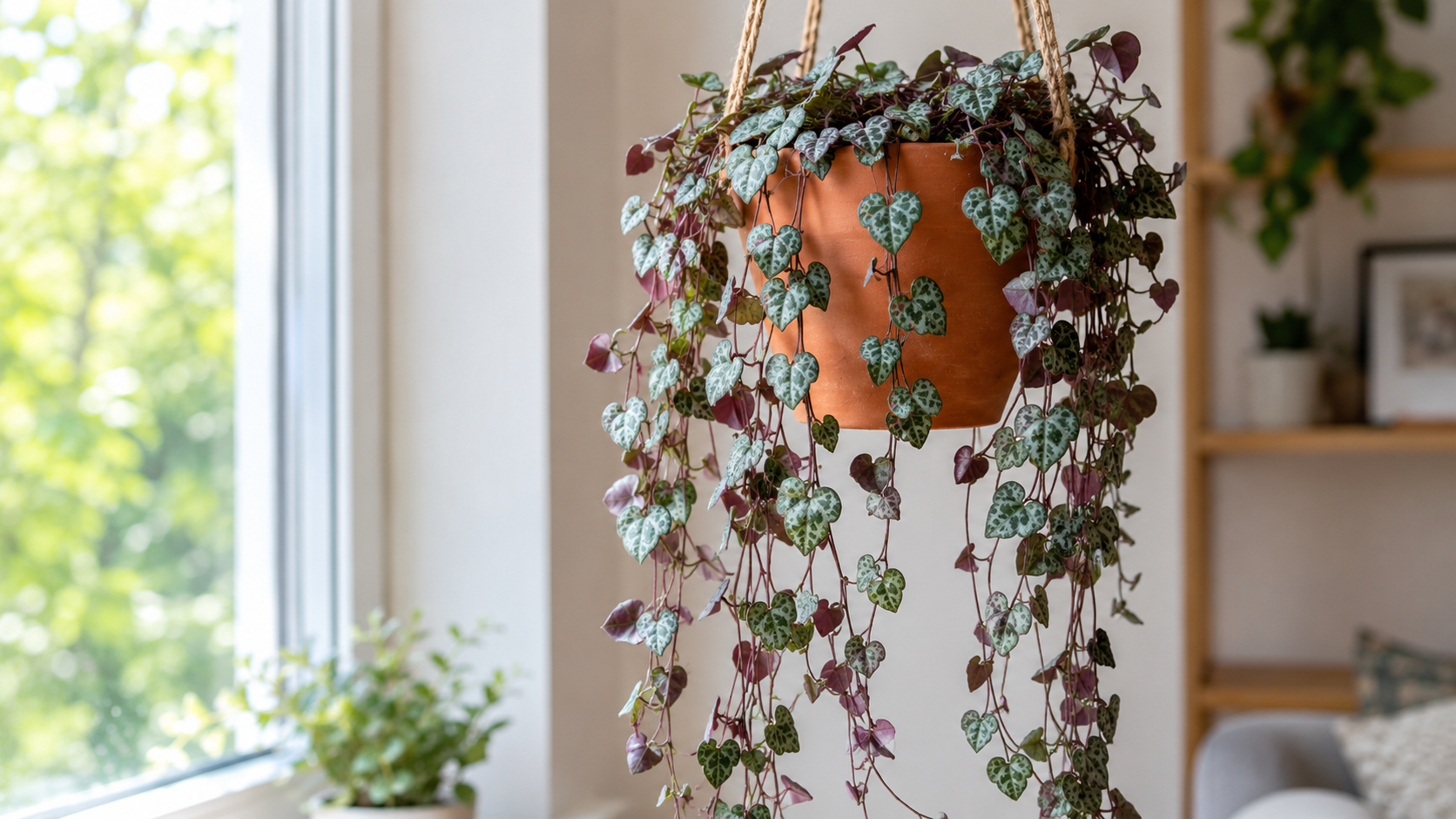
How to Grow a String of Hearts in Hanging Containers
String of Hearts (Ceropegia woodii) is an excellent choice for anyone who wants to bring natural beauty into a room without taking up valuable shelf or floor space. Its delicate trailing stems, heart-shaped leaves, and silver-green patterns create an attractive living display in hanging baskets, near bright windows, or on elevated plant stands.
Although this plant is often considered easy to grow, its succulent-like leaves and tuberous roots require a different approach from that used for moisture-loving houseplants. The key is to provide enough light, choose a container that drains properly, and avoid keeping the roots constantly wet.
With the right setup and a simple care routine, you can encourage fuller growth, maintain attractive foliage, and propagate new plants from the vines.
1. Choose the Right Hanging Container
String of Hearts Care and Propagation | Leafy Zen
The container affects how easily you can water your String of Hearts and how quickly its roots dry after watering. A beautiful hanging pot is useful only if it also provides suitable growing conditions.
What type of pot works best?
Choose a lightweight container with drainage holes at the bottom. Plastic nursery pots placed inside decorative hanging baskets are particularly practical because you can remove the inner pot for watering and let excess water drain before rehanging it.
Terracotta is another good option because its porous walls allow moisture to evaporate more readily. However, terracotta dries faster than plastic, so you may need to check the soil more frequently.
For a newly purchased plant, a pot approximately 4–6 inches (10–15 cm) wide is often sufficient, depending on the size of its root system. Avoid choosing a very large container simply to accommodate future growth. Excess soil can remain wet longer than the roots can comfortably tolerate.
Before planting, check these essentials:
- The pot has unobstructed drainage holes.
- The hanging support can safely carry the weight of the wet container.
- The basket is easy to reach for watering and inspection.
- The vines have enough clearance to hang without rubbing against furniture or being frequently disturbed.
If your decorative basket has no drainage holes, keep the plant in a separate draining pot inside it. Never allow water to collect unnoticed at the bottom of the outer container.
2. Use a Fast-Draining Potting Mix
String of Hearts is native to southern Africa, where it grows in conditions that differ from the consistently moist environment preferred by many tropical houseplants. Its thickened leaves and tuberous structures help it store water, making an airy, well-drained growing medium essential.
A dense potting mix that remains wet for days can deprive the roots of oxygen and increase the risk of rot.
How to prepare the soil
You can use a commercial cactus and succulent potting mix or improve a standard indoor potting mix by adding extra perlite or another suitable drainage material.
A practical starting mixture is:
- Two parts cactus and succulent potting mix.
- One part perlite or pumice.
Mix the ingredients evenly so water can pass through the root zone without the medium collapsing into a dense mass. The precise ratio can vary depending on the original mix, the climate, and the container material.
If your home is humid or the soil dries slowly, a more mineral, airy mixture may be useful. In a particularly warm, dry room, a slightly more moisture-retentive mix may work better, provided it still drains freely.
Avoid using ordinary garden soil in a hanging pot. It can compact, weigh down the container, and retain too much moisture indoors.
3. Find the Best Light for Healthy Vines
Light is one of the most important factors in growing an attractive String of Hearts. The plant needs enough brightness to maintain compact growth, well-defined leaf patterns, and healthy trailing stems.
A location near a bright window is generally a good starting point. An east-facing window often provides gentle morning sunlight, while a bright west-facing window may offer stronger afternoon light that requires some protection.
Bright indirect light or direct sunlight?
Bright indirect light is a reliable choice, but the plant can also benefit from a few hours of gentle direct sunlight when gradually acclimated. Harsh afternoon sun through glass may scorch the leaves, particularly if the plant has previously been kept in a dim location.
Watch the foliage and the spacing between leaves to evaluate its position.
- Long stems with widely spaced leaves: The plant may need more light.
- Pale or less distinct leaf markings: Insufficient light may be contributing.
- Brown, dry patches on exposed leaves: Excessive direct sun may be responsible.
- Healthy, compact growth: The current position may be suitable.
These signs are clues rather than definitive diagnoses. Watering problems, temperature changes, and other environmental stresses can also affect foliage.
If you move the plant to a brighter location, increase its exposure gradually. This is especially important when moving an indoor plant outdoors during warm weather.
4. Water Correctly Without Causing Root Rot
Overwatering is one of the most common problems affecting String of Hearts. Although the leaves may look delicate, they store moisture, so the plant does not need frequent watering simply because its stems are thin.
The goal is to water thoroughly when the growing medium has dried sufficiently, then allow excess water to escape.
How to water a hanging basket
- Check the soil with your finger or a wooden stick. Examine the moisture below the surface rather than relying only on the appearance of the top layer.
- If the mix is still damp, wait and check again later.
- Once the growing medium is dry throughout or nearly dry, depending on the mix and growing conditions, water evenly until excess water drains from the bottom.
- Allow the pot to drain completely before placing it back inside its decorative basket.
- Empty any collected water and check the plant again as the soil dries.
There is no universally correct watering schedule. A plant in a warm, bright room may dry much faster than one in a cool room with limited light. Pot size, material, airflow, and season also influence how often watering is necessary.
During cooler months, growth commonly slows and the plant generally needs less water. Continue checking the soil rather than following the same schedule used during active growth.
Important: Do not compensate for dry-looking leaves by repeatedly adding small amounts of water. Check the soil and roots first, because both underwatering and root damage can produce similar symptoms.
5. Maintain a Comfortable Temperature and Humidity
String of Hearts adapts well to normal indoor temperatures. A warm room with good air circulation generally provides suitable conditions, while cold drafts and sudden temperature changes can stress the plant.
Keep it away from freezing conditions, poorly insulated windows during cold nights, and direct blasts of hot or cold air from heating and cooling equipment.
Unlike many tropical foliage plants, String of Hearts does not require unusually high humidity. Average household humidity is usually adequate, and misting the leaves is unnecessary.
In humid homes, pay particular attention to soil drainage and how long the potting mix remains wet. Good airflow around the hanging basket can help the growing medium dry more evenly.
6. Feed the Plant Without Overfertilizing
String of Hearts does not need heavy feeding to produce long, attractive vines. Too much fertilizer can encourage weak growth and cause salts to accumulate in the potting medium.
During active growth in spring and summer, apply a balanced liquid houseplant fertilizer diluted according to its label. A conservative approach is to use half the recommended strength when appropriate for that product.
Follow these guidelines:
- Fertilize only when the plant is actively growing.
- Apply fertilizer to appropriately moist soil rather than severely dry roots.
- Avoid feeding a plant that is stressed, suffering from root rot, or recently repotted into a fertilized mix.
- Reduce or stop feeding during winter dormancy or slower growth.
More fertilizer does not necessarily produce fuller vines. Adequate light, healthy roots, and appropriate watering have a greater influence on the plant’s overall condition.
7. Encourage Fuller Growth Through Pruning and Propagation
Variegated String of Hearts Care Guide (Ceropegia Woodii) • Feral Foliage
A String of Hearts can produce long trailing stems, but a plant with only a few vines may look sparse near the top of its hanging pot. Pruning and propagation can help create a fuller appearance without requiring a larger container.
How to prune long or damaged stems
Use clean, sharp scissors to remove dead sections or shorten vines that have become inconveniently long. Cut just above a healthy node, where a leaf or new growth may emerge.
Avoid removing a large proportion of healthy foliage at once. If the plant is already weak or growing in poor light, correct those conditions before carrying out substantial pruning.
How to propagate new plants
String of Hearts can be propagated using stem cuttings or the small tubers that sometimes form along its vines.
- Select a healthy vine with several intact nodes.
- Cut a section with clean scissors, making sure it contains multiple nodes.
- Lay the cutting on the surface of a small pot filled with a moist, well-draining propagation mix.
- Position one or more nodes against the medium and secure the vine gently if necessary.
- Keep the mix lightly moist, not waterlogged, while roots establish.
- Provide bright indirect light and check for new growth over the following weeks.
You can also press an aerial tuber against the soil while it remains attached to the parent vine. Once it has rooted and established growth, separate it if desired.
Propagation speed varies with temperature, light, and the condition of the cutting. Avoid pulling on a cutting to test its roots repeatedly, because newly developing roots are delicate.
For a fuller hanging display, several rooted cuttings can be planted around the edge of the same pot, provided the container has enough room and drainage.
8. Repot Only When Necessary
String of Hearts often grows well with its roots relatively snug in the container. Repotting too frequently can disturb its tubers and roots unnecessarily.
Consider repotting when roots densely fill the pot, the growing medium has deteriorated, or the plant dries out unusually quickly despite appropriate watering.
Spring is a convenient time because active growth can help the plant recover. Choose a pot only slightly larger than the existing root ball, and use fresh, fast-draining mix.
Handle the roots gently, particularly if you notice small tubers. After repotting, water according to the moisture level of the new mix and allow the pot to drain completely.
If the plant is healthy and growing well, there is no need to repot it simply because its vines have become longer.
9. Troubleshoot Common String of Hearts Problems
When a plant starts looking unhealthy, inspect the growing conditions before changing several things at once.
| Symptom | Possible cause | What to do |
|---|---|---|
| Yellowing leaves | Excess moisture, root problems, or environmental stress | Check soil moisture, drainage, and roots before watering again. |
| Wrinkled or limp leaves | Underwatering or damaged roots | Check whether the soil is dry or persistently wet, then adjust accordingly. |
| Long gaps between leaves | Insufficient light | Move the plant gradually to a brighter position. |
| Dry, brown patches | Excessive direct sunlight or other stress | Assess sun exposure and recent environmental changes. |
| Soft, dark stems near the soil | Possible stem or root rot | Remove the plant from standing water and inspect damaged tissue and roots. |
| White, cotton-like clusters | Possible mealybugs | Isolate the plant, inspect leaf joints, and use a suitable treatment according to its label. |
Mealybugs, scale insects, aphids, and spider mites can occasionally affect indoor plants. Inspect the undersides of leaves and the areas where stems meet the foliage.
If pests appear, isolate the affected plant and begin with appropriate physical removal and cleaning. Use a labeled plant treatment if necessary, following the product instructions and any relevant household safety precautions.
Do not assume every yellow leaf indicates overwatering. A plant with damaged roots can wilt even when its soil is wet, which is why checking the actual growing conditions matters.
10. Frequently Asked Questions
How long can String of Hearts vines grow?
The vines can reach several feet in suitable conditions, with some plants growing considerably longer. Growth rate and eventual length depend on light, temperature, root health, and the individual plant.
Can String of Hearts grow in a bathroom?
Yes, if the bathroom receives enough natural light and the potting mix drains properly. A dark bathroom is not suitable simply because it has higher humidity. A bright window is more important than frequent misting.
Why is my String of Hearts not growing?
Insufficient light, cool temperatures, seasonal dormancy, and root problems can all slow growth. Check the light level and roots before increasing fertilizer or watering more frequently.
Is a hanging basket better than a regular pot?
A hanging basket displays the trailing vines beautifully, but the plant can also grow in a standard pot on a shelf. The important factors are drainage, adequate light, and access for routine care.
Does String of Hearts need frequent watering in summer?
Not necessarily. Warm weather may increase water use, but the potting mix should still dry sufficiently between waterings. Check the soil rather than watering automatically every few days.
Create a Healthy Hanging Display That Lasts
Growing String of Hearts successfully is less about constant attention and more about getting a few essentials right. Start with a draining container, a loose potting mix, and a bright position that protects the foliage from harsh sunlight.
As the vines develop, observe their leaf spacing, firmness, and color. Adjust watering to the actual moisture in the soil, prune only when needed, and use healthy cuttings to fill out sparse areas.
With consistent care and occasional inspection, your hanging container can develop into an attractive display of cascading heart-shaped leaves without complicated maintenance.