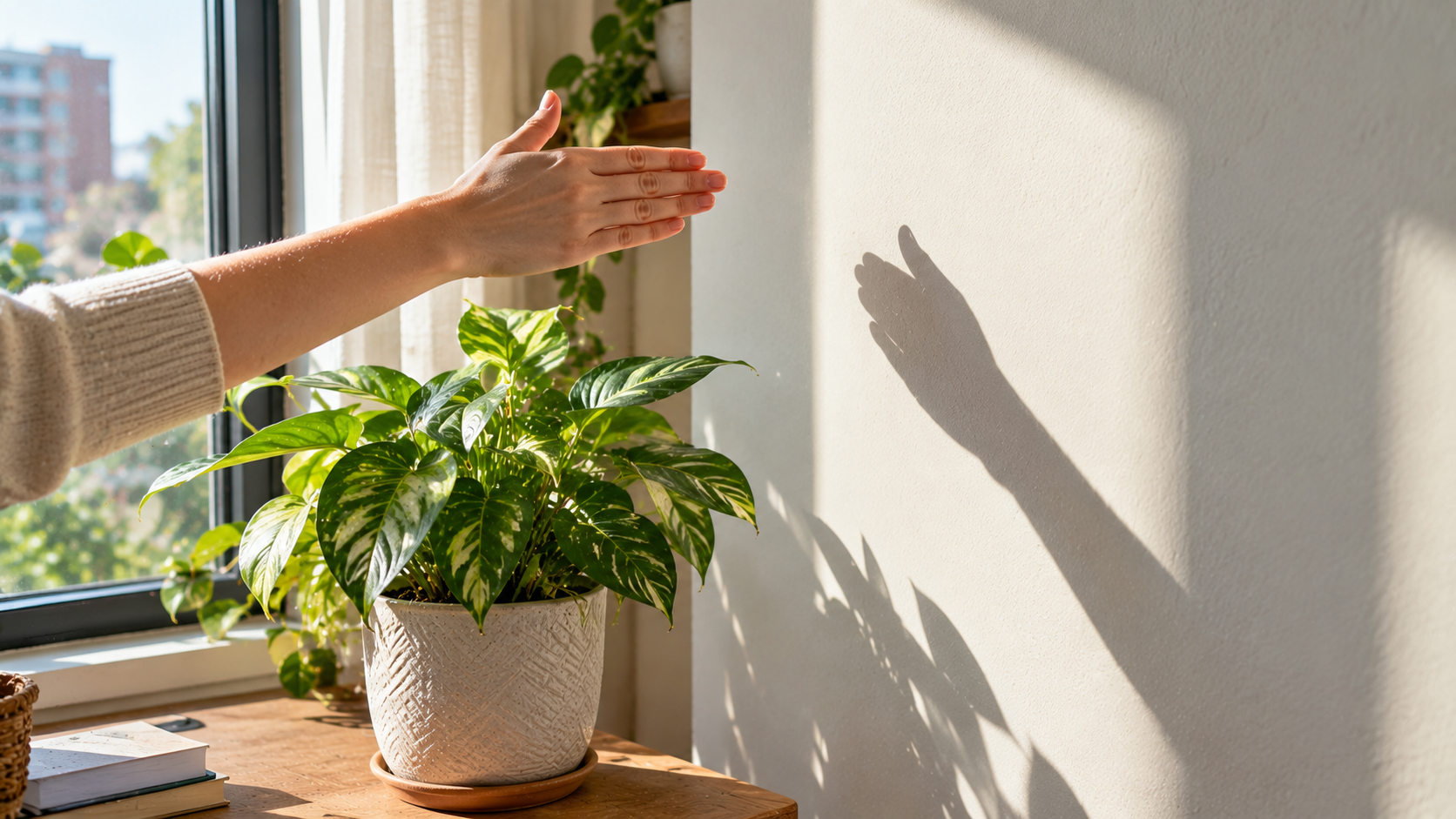
When choosing a place for a houseplant, a room may look bright to your eyes but still provide less light than the plant needs. One simple way to investigate is to observe the shadow cast by your hand on a nearby wall. The shadow’s sharpness, darkness, and definition can offer clues about the amount of directional sunlight reaching that spot.
This method is useful for comparing locations around your home without buying equipment. However, it is a visual estimate, not a precise measurement of the light plants receive. By combining the shadow test with observations of the window, time of day, and plant’s needs, you can make better decisions about where to place your plants.
What Does a Wall Shadow Tell You About Light?
A shadow forms when an object blocks light from reaching a surface. When sunlight comes directly through a window, it often creates a distinct shadow with recognizable edges. When light arrives from many directions—because it is scattered by clouds, curtains, or nearby surfaces—the shadow tends to look softer and less defined.
The difference can help you distinguish between direct sunlight and more diffuse light in a room.
Sharp, dark shadows
A clearly outlined shadow with dark areas usually indicates that a strong, directional light source is reaching the wall. If sunlight is passing directly through an unobstructed window, objects near that window may cast sharp shadows.
This can suggest that the area receives direct sunlight at that moment. It does not automatically mean the entire room is bright throughout the day, nor does it establish whether a particular plant will tolerate the conditions.
Soft, blurry shadows
A shadow with fuzzy edges and little contrast often indicates that light is more diffuse. This can happen when sunlight is filtered through sheer curtains, scattered by clouds, or reflected around the room.
Many tropical foliage plants prefer bright, indirect light, but the phrase “indirect light” covers a wide range of conditions. A soft shadow can be a useful clue, yet it cannot tell you by itself whether the light intensity is sufficient.
Little or no visible shadow
If your hand barely casts a shadow, the area may have weak directional light or be receiving mostly diffuse illumination. A distant corner, a room with a small window, or a location blocked by buildings may show this pattern.
Still, the absence of a strong shadow does not prove that a space is unsuitable for all plants. Some species tolerate lower light levels, while others need considerably brighter conditions to grow well.
How to Perform the Wall Shadow Test
You do not need special tools. You only need a hand, a wall or other plain surface, and a little time to observe how light changes.
Step 1: Choose a suitable wall
Find a pale, matte wall near the window or the place where you are considering putting a plant. White or light-colored surfaces make shadows easier to see than dark or heavily patterned walls.
Avoid judging the room from a spot far away from the plant’s intended position. Light intensity can drop considerably as distance from a window increases.
Step 2: Hold your hand between the light and the wall
Stand where you intend to place the plant, or as close to that position as practical. Hold your hand several inches in front of the wall, between the incoming light and the surface.
Move your hand slightly and observe the outline. Is it crisp and dark, soft and faint, or barely visible? Keep the hand and wall in roughly the same positions when comparing different locations.
Step 3: Repeat the test at different times
Light changes with the sun’s position, cloud cover, season, and nearby obstructions. A window may receive direct sunlight in the morning but be shaded in the afternoon.
Try the test in the morning, around midday, and later in the day when possible. Record whether the shadow changes and how long direct sunlight reaches the area. One observation cannot represent the room’s full daily light pattern.
Step 4: Compare several locations
Test the windowsill, a table a short distance from the window, and a farther corner. Use similar conditions and the same hand position for each observation.
This comparison helps reveal which locations receive stronger directional light. It is particularly useful when deciding whether to move a plant closer to a window or choose a different species for a darker area.
How to Interpret the Results for Houseplants
The shadow test is best treated as a practical screening tool, not a universal light scale. Use it alongside information about the species and the actual growing location.

A distinct, sharp shadow
This suggests strong directional light at the time of observation. It may suit plants that need brighter conditions, including some succulents and flowering plants, if the light duration and temperature are appropriate. Acclimate plants gradually to direct sun to reduce the risk of leaf scorch.

A soft but visible shadow
This indicates some directional light mixed with diffuse illumination. It may be suitable for plants that prefer bright, indirect light, depending on intensity, distance from the window, and the length of exposure.

A faint or nearly invisible shadow
This may indicate low directional light. Consider plants known to tolerate lower indoor light levels, or evaluate whether a suitable grow light is needed. Remember that low-light tolerance does not mean a plant can thrive indefinitely in darkness.
University extension guidance emphasizes that houseplant lighting depends on intensity, duration, and the plant species. A room that looks bright to a person may provide relatively little light for photosynthesis because human vision adapts to different brightness levels.
Why the Shadow Test Is Not Enough on Its Own
The same wall shadow can look different depending on several factors. Understanding these limitations prevents you from moving a plant unnecessarily or assuming that a room is too dark based on one observation.
Window direction and outdoor obstructions
The direction a window faces influences when it receives direct sunlight, but the view outside matters too. Trees, balconies, neighboring buildings, roof overhangs, and insect screens can reduce the light entering a room.
A large window facing a shaded courtyard may provide less light than a smaller window with an unobstructed view of the sky. Check what is outside the window, not just its size or orientation.
Curtains, glass, and wall color
Sheer curtains scatter and reduce incoming sunlight. Tinted glass, dirty windows, and screens can also affect the amount of light that reaches plants. Pale walls may reflect some light back into a room, while dark furnishings absorb more of it.
These factors influence the appearance of shadows as well as the overall light available to a plant. A bright-looking wall is not necessarily proof that the leaves receive enough usable light.
Weather and season
A test performed on a sunny day may produce a strong shadow, while an overcast day produces a much softer one. Both observations can be useful, but they represent different conditions.
Seasonal changes also matter. The sun’s path changes throughout the year, and nearby trees may block different amounts of light as their foliage changes. If you are evaluating a permanent plant location, observe it on more than one day.
A More Reliable Way to Assess Light
If you want to make a more confident decision, combine the shadow test with a few additional checks.
- Observe direct sunlight. Note whether the sun actually reaches the leaves, rather than merely illuminating the wall or floor nearby.
- Estimate the daily duration. Record when direct sunlight begins and ends, and whether the rest of the day is bright or dim.
- Check at leaf level. A reading at the window may differ greatly from the light reaching a plant several feet away.
- Use a light meter if needed. A handheld meter can measure illuminance in lux or foot-candles. Smartphone apps can offer rough comparisons, but their accuracy varies by device and app.
- Compare the results with the plant’s needs. Look up guidance for the particular species rather than relying only on broad labels such as “low light” or “bright indirect light.”
For plants under grow lights, measurements designed for plant-useful light, such as photosynthetic photon flux density (PPFD), can provide more relevant information than ordinary brightness readings. For most casual indoor gardeners, however, the shadow test and careful observation are useful starting points.
Common Mistakes to Avoid
- Testing only once: A strong morning shadow does not mean the room receives strong light all day.
- Confusing brightness with direct sun: A room can be brightly illuminated by diffuse daylight without the sun’s rays reaching the plant.
- Putting every plant in the sunniest spot: Some foliage plants are damaged by intense direct sunlight, especially if they have not been acclimated.
- Calling a room “low light” because of one faint shadow: The wall’s position, weather, and light direction may affect the result.
- Ignoring plant growth: Persistent stretching, pale new growth, or poor flowering can indicate insufficient light, although other problems may cause similar symptoms. Bleached or scorched leaves may indicate excessive exposure or heat.
Frequently Asked Questions
Does a sharp shadow mean the light is good for every plant?
No. It suggests that directional light is strong at that moment, but different species have different needs. Some plants benefit from direct sun, while others need protection from intense rays.
Can I use the test on a cloudy day?
Yes, but interpret the result in context. Overcast skies diffuse sunlight, so shadows are often softer. Repeat the observation under different conditions to understand how the location changes.
Is a room without visible shadows unsuitable for houseplants?
Not necessarily. Some plants tolerate low light, and a room may still receive diffuse daylight. However, a very dim location may not support sustained healthy growth, even for plants marketed as low-light tolerant.
Should I move a plant as soon as I notice a faint shadow?
Not based on that observation alone. Consider the species, window distance, daily light pattern, and signs of growth. If you move the plant to a brighter place, increase exposure gradually when direct sunlight is involved.
Make the Shadow Test Part of Your Plant-Care Routine
A wall shadow is a simple way to compare light around your home without relying entirely on how bright a room feels. Look at its definition, repeat the test at different times, and combine what you see with the plant’s requirements and growth.
The most useful decision comes from several clues rather than one shadow. Choose a location that provides the right balance of intensity and duration for the species, then observe the plant’s response before making further changes.