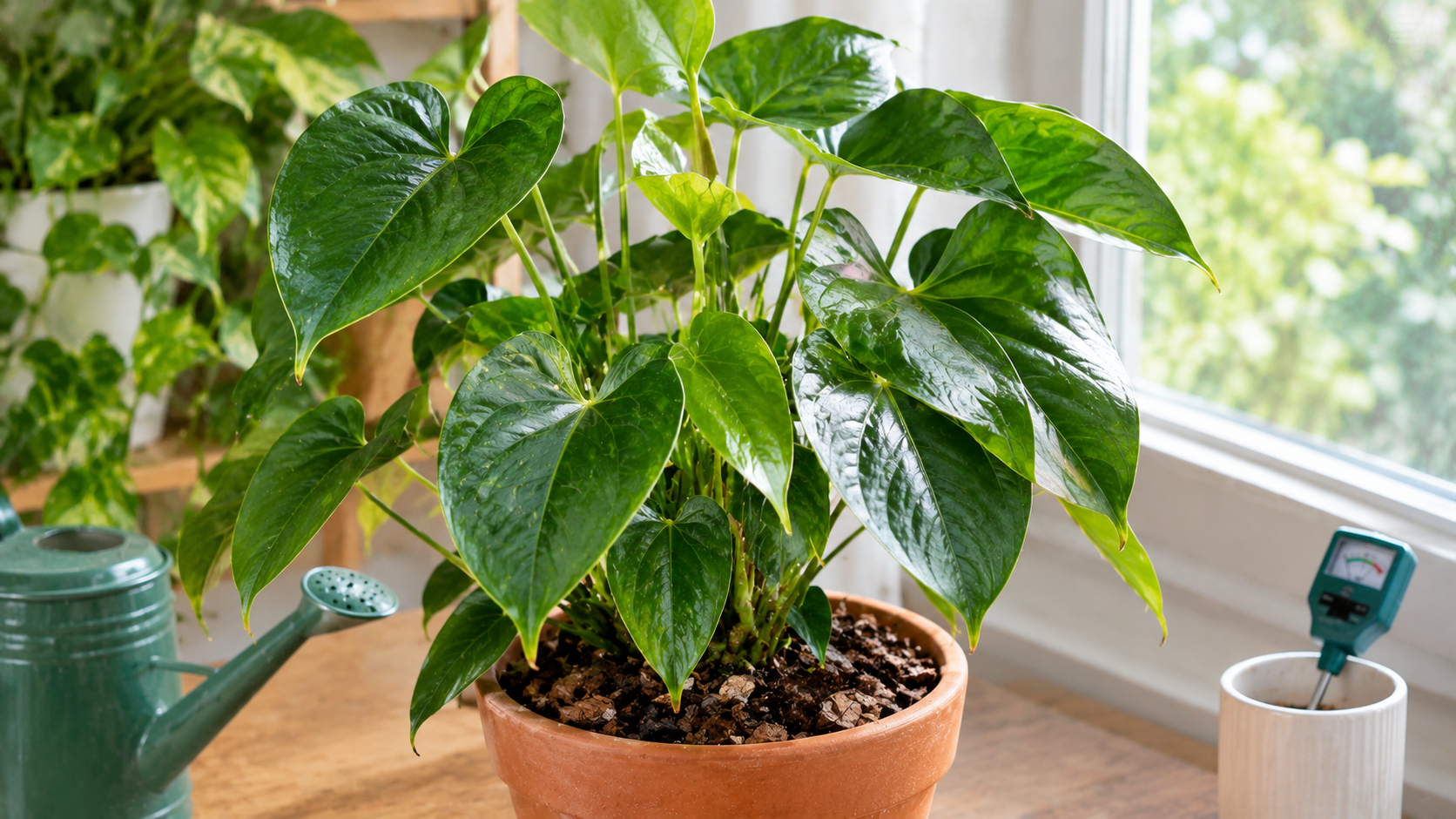
An anthurium can look healthy, with glossy green leaves and firm stems, yet produce no flowers for months. This can be confusing, especially when the plant continues to grow and appears to be receiving proper care.
The reason is that attractive foliage does not necessarily mean an anthurium has everything it needs to flower. Light intensity, temperature, humidity, root health, watering, and nutrition all influence its growth. A plant may maintain its leaves under conditions that are not ideal for regular flowering.
Before increasing fertilizer or moving the plant repeatedly, review its growing environment. Identifying the most likely limitation can help you make targeted adjustments without creating additional stress.
Why Does an Anthurium Grow Leaves but Not Flowers?
Anthuriums are tropical plants, and many commonly grown varieties are cultivated for their colorful, long-lasting flower structures. What people often call the flower is actually an inflorescence consisting of a spadix and a colorful spathe.
A plant can produce healthy leaves while directing its available resources toward vegetative growth rather than flowering. This does not automatically mean something is wrong. Young plants, recently repotted anthuriums, and plants adjusting to a new location may need time before flowering becomes consistent.
However, if a mature plant has stopped flowering for a long period, its growing conditions deserve closer inspection.
The key is to distinguish between a normal pause in flowering and an environmental limitation. Look at the plant’s recent growth, the season, and the conditions it receives rather than relying on leaf appearance alone.
1. Check the Light Before Changing Anything Else
Insufficient light is one of the first conditions to investigate when an anthurium has beautiful leaves but no flowers. A plant may survive in a dim corner and continue producing foliage, but flowering can become less frequent when available light is too low.
How to recognize a light problem
Look at where the plant sits throughout the day, not just how bright the room appears to you. A room can feel bright while the plant receives little usable light, particularly when it is several feet from a window or shaded by curtains, buildings, or trees.
Possible clues include:
- Long periods without new flowers.
- Slow growth despite otherwise healthy leaves.
- New leaves that are smaller than previous ones.
- A position far from windows or behind heavy curtains.
These signs are not conclusive on their own, but they help you assess whether the plant receives enough light.
Where should an anthurium be placed?
Choose a location with bright, indirect light. An east-facing window may provide suitable morning light, while a bright south- or west-facing window may work if the plant is protected from harsh direct sun.
Avoid placing the plant in intense midday sunlight, which can scorch the leaves. If it currently sits in a dark corner, move it gradually to a brighter location and observe how it responds.
Do not expect flowers to appear immediately after moving the plant. The goal is to improve the conditions that support future flowering, not to force an instant result.
2. Review Temperature and Humidity
Anthuriums come from tropical environments, so prolonged cold, dry air, and sudden temperature changes can interfere with healthy growth.
Keep temperatures comfortably warm
For many popular flowering anthuriums, a consistently warm indoor environment is preferable to a room that becomes cold at night. The Royal Horticultural Society recommends keeping Anthurium andraeanum above 18°C, while North Carolina State Extension gives a preferred range of approximately 18–29°C for common anthuriums.
Avoid placing the pot beside air-conditioning outlets, cold windows, frequently opened exterior doors, or heaters that produce intense dry heat.
If the plant is near a window, consider how the temperature changes after sunset. A location that is suitable during the day may become too cold overnight.
Is the air too dry?
Low humidity can contribute to brown leaf tips, dry edges, and reduced foliage quality. These symptoms do not automatically explain a lack of flowers, but they may indicate that the environment is less suitable than the plant needs.
If indoor air is consistently dry, consider using a room humidifier. Grouping plants can also create a slightly more humid local environment, although the effect varies with room ventilation and plant density.
A pebble tray may provide a small local effect, but it is not a substitute for adequate room humidity. Keep the pot above the water level rather than allowing its base to sit in standing water.
3. Check Watering and Root Health
Healthy leaves do not guarantee healthy roots. An anthurium may maintain attractive foliage for a time even when its growing medium is too wet, too compact, or unsuitable for its roots.
Avoid constantly wet potting mix
Anthuriums need moisture, but their roots also require oxygen. If the potting mix remains saturated for long periods, roots can deteriorate and become less effective at absorbing water and nutrients.
Check the growing medium about 2–5 cm below the surface. If it is still very wet, wait before watering again. If it has become noticeably drier, water thoroughly and allow excess water to drain.
The correct interval depends on pot size, room temperature, light, humidity, and the composition of the growing medium. A fixed weekly schedule is less reliable than checking the actual moisture level.
Use an airy, well-drained growing medium
A dense mix that compacts over time can hold too much water around the roots. A suitable anthurium mix should retain some moisture while allowing excess water and air to move through it.
An open mix containing ingredients such as orchid bark, perlite, and an appropriate potting base can help create this balance. The exact proportions depend on the plant, local conditions, and the materials available.
Inspect the roots if the plant has persistent wet soil, an unpleasant smell, or declining growth. Healthy roots are generally firm, while rotting roots may be dark, soft, and damaged.
Repot only when there is a reason, such as deteriorated potting mix, root rot, or a severely root-bound plant. Unnecessary repotting can add stress and delay recovery.
4. Is Fertilizer the Missing Ingredient?
Fertilizer can support flowering, but more is not always better. An anthurium may produce plenty of leaves without flowers because light is inadequate, not because it needs a stronger fertilizer.
During active growth, use a balanced fertilizer suitable for flowering tropical houseplants, following the product’s label for dilution and frequency. Some growing guides recommend orchid fertilizer for anthuriums because of their preference for an airy, organic growing medium.
Before feeding, consider these questions:
- Has the plant been actively growing?
- Has it been fertilized recently?
- Is there a crust of mineral or fertilizer salts on the soil?
- Is the plant receiving enough light to support active growth?
Avoid using concentrated fertilizer or repeatedly applying products marketed specifically for flowering. Excess fertilizer salts can damage roots and cause leaf-tip browning. Correct the growing conditions first if the plant is stressed.
Also remember that a newly purchased plant may still be responding to conditions at the nursery. Follow the care instructions for the specific product and avoid adding extra fertilizer simply because flowers have not appeared yet.
5. Does the Pot Size or Plant’s Age Matter?
Yes. A young anthurium may need time to mature before it flowers reliably. Some plants sold with colorful spathes are already mature specimens, while smaller plants may initially focus on developing roots and foliage.
Pot size also matters, although a larger container is not automatically better. An oversized pot can retain moisture longer than the roots can use it, increasing the risk of root problems. Conversely, a severely root-bound plant may benefit from repotting into a slightly larger container.
Look for roots emerging from drainage holes, a potting mix that dries unusually quickly, or roots densely circling the inside of the container. Repot in a suitable growing season if these signs indicate that the plant needs more room.
Remember that some anthurium species are grown primarily for decorative foliage rather than showy flowers. If you have a foliage-focused species, its flowering behavior may differ from that of the familiar red or pink Anthurium andraeanum.
6. A Simple Checklist to Encourage Flowering
Before making several changes, review these conditions in order:
- Light: Is the plant receiving bright, indirect light for much of the day?
- Temperature: Is it kept in a warm location away from cold drafts?
- Humidity: Is the air excessively dry, especially near heating or air-conditioning?
- Watering: Does the growing medium approach dryness before the next watering, without remaining saturated?
- Roots and potting mix: Is the mix airy and well drained, with no obvious signs of root rot?
- Nutrition: Is the plant receiving appropriate fertilizer during active growth, without excessive feeding?
- Maturity: Is it a flowering variety old enough to bloom, or is it still establishing itself?
Make the most important correction first. For example, if the anthurium sits in a dim hallway, improving light is likely a more useful first step than buying a flowering fertilizer.
Track new growth and flowering over the following weeks and months. The time required for a response depends on the plant’s condition, maturity, variety, and growing environment.
Frequently Asked Questions
How long does an anthurium take to flower again?
There is no guaranteed timeline. A mature, healthy plant in suitable conditions may flower repeatedly, while one recovering from stress may need several months before producing new blooms.
Should I cut off old leaves to encourage flowers?
Remove dead or badly damaged leaves with clean tools, but do not remove healthy foliage simply to stimulate flowering. Healthy leaves help the plant capture the light needed for growth.
Can an anthurium flower without direct sunlight?
Yes. Bright, indirect light is generally preferable indoors. Direct sunlight is not necessary and may scorch the leaves.
Focus on the Conditions That Support Blooms
An anthurium with attractive leaves but no flowers does not necessarily need more fertilizer or a new pot. Start by reviewing light, warmth, watering, root health, and the plant’s maturity. Make gradual, targeted changes and observe how new growth develops before adjusting anything else.
Healthy foliage is a useful starting point, but consistent flowering depends on the plant receiving the right conditions—not simply looking green and glossy.