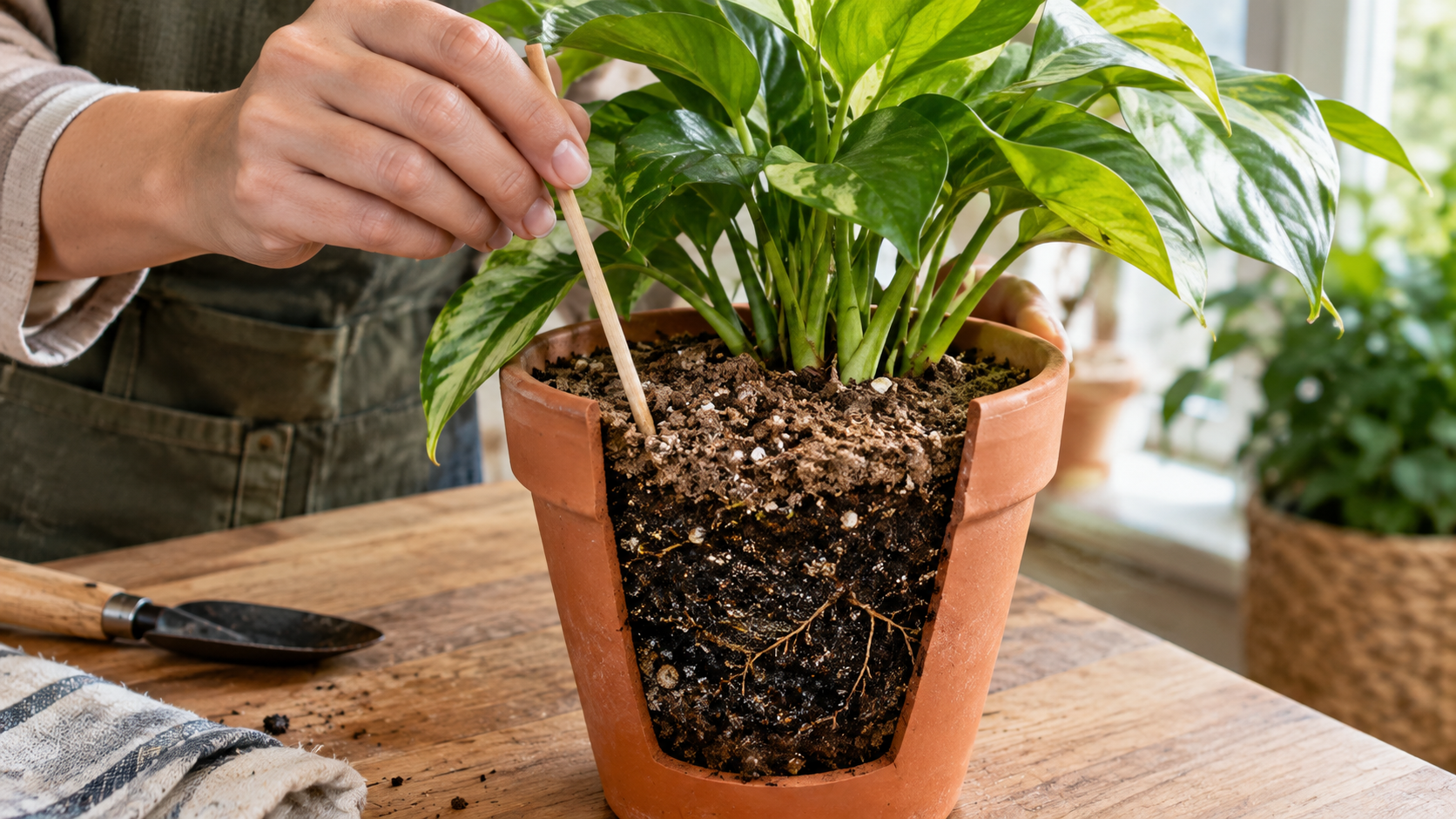
You look at your houseplant, notice that the top of the soil feels dry, and reach for the watering can. But what if the soil underneath is still moist? Or what if the surface looks dark and damp while the roots are sitting in a dry pocket of potting mix?
Knowing how to check soil moisture below the surface is one of the most useful skills in everyday plant care. The top layer dries faster than the lower layers in many pots, so judging moisture by appearance alone can lead to overwatering or underwatering.
Fortunately, you do not need expensive equipment to determine whether your plant needs water. A simple finger test, a wooden skewer, the weight of the pot, and a basic understanding of your plant’s needs can help you make a more informed decision.
Why the Soil Surface Can Be Misleading
The surface of potting soil is exposed directly to air, light, and changes in temperature. Water evaporates from this layer, so it may become dry while the deeper soil remains moist.
The opposite can happen, too. A quick splash of water may darken the surface without reaching the full root zone, especially when the potting mix has become compacted or water-resistant.
Several factors influence how moisture is distributed inside a container:
- Pot depth: Taller pots can retain moisture in their lower layers after the surface dries.
- Potting mix: Fine-textured mixes often retain more water than coarse, airy mixes.
- Container material: Unglazed terracotta allows moisture to evaporate through its walls more readily than plastic or glazed ceramic.
- Plant size: A large, actively growing plant may use water faster than a small plant in similar conditions.
- Environment: Warm temperatures, sunlight, airflow, and humidity all affect how quickly soil dries.
According to university extension guidance, plant species, container size, growing medium, and environmental conditions should all be considered when deciding when to water. A dry surface alone is not a universal signal that watering is necessary.
University of Maryland Extension
+1
5 Practical Ways to Check Soil Moisture Below the Surface
You can combine these methods for a more reliable assessment instead of relying on a single sign.
1. Use the finger test

The finger test is the easiest starting point for most small and medium-sized houseplants.
How to do it:
- Insert your finger into the soil about 1–2 inches (2.5–5 cm) deep.
- Feel whether the mix is cool, damp, slightly moist, or dry.
- If the pot is deep, check another accessible spot closer to the middle of the root zone.
- Compare what you feel with the moisture level preferred by that plant species.
If the soil feels damp at this depth, a plant that prefers moderate drying may not need water yet. If it feels dry, watering may be appropriate, depending on the plant’s requirements.
This method works best when you can reach the growing medium without disturbing the roots. It is less useful for very large pots, dense root systems, and plants with specific moisture requirements that differ from those of common houseplants.
2. Insert a wooden skewer or chopstick
A clean, untreated wooden skewer can help you check deeper soil when your finger cannot reach far enough.
Follow these steps:
- Push the skewer carefully into the pot, avoiding the main stem and any obvious roots.
- Leave it in place for a short moment.
- Withdraw it slowly and examine the section that was buried.
- Look and feel for darkened wood, damp soil clinging to the surface, or a cool, moist texture.
A skewer that comes out nearly clean and dry suggests that the area it passed through contains little moisture. Darkened wood or damp soil adhering to it suggests moisture is present.
This is a practical indicator rather than a precise measurement. Some potting mixes cling to wood even when they are only slightly moist, and a single insertion may miss a wet or dry pocket elsewhere in the pot.
If the plant is valuable or has a dense root system, insert the skewer gently and do not force it through resistance.
3. Compare the weight of the pot

Water adds considerable weight to a container. As the potting mix dries, the pot generally becomes lighter, making weight a useful additional clue.
To learn this method, lift the pot after watering and allowing the excess water to drain. Remember how heavy it feels, or weigh it on a scale if the container is small enough. Lift it again over the following days and compare the change.
A pot that feels much lighter than its usual freshly watered weight may need water. A pot that remains heavy may still contain substantial moisture, even when the surface appears dry.
This technique becomes more useful as you learn the normal drying pattern of each plant. However, plant growth, decorative outer pots, and accumulated water in a saucer can affect the weight, so combine it with another check.
4. Use a soil moisture meter carefully
A moisture meter can help when the pot is too large for the finger test or when you want to check a deeper area of the root zone.
Insert the probe according to the manufacturer’s instructions, then read the result in the context of the plant’s needs. If possible, compare readings at different depths and locations rather than assuming that one measurement represents the entire pot.
Keep in mind that inexpensive meters are not always accurate. Their readings can be affected by the growing medium, probe condition, and other factors. Treat the result as supporting evidence, not an automatic instruction to water.
For an unfamiliar plant, compare the meter reading with the soil’s actual feel and the weight of the container before making a decision.
Ask Extension
+1
5. Observe how water behaves when you water
Water movement can reveal whether the potting mix is absorbing moisture evenly.
If water is poured onto very dry soil and immediately rushes through the drainage holes, it may be moving through gaps along the pot’s edges instead of soaking the root zone.
On the other hand, if water remains on the surface for a long time, the mix may be compacted or poorly draining.
Neither sign tells the whole story by itself. The important question is whether the growing medium becomes evenly moist without remaining saturated for too long.
Virginia Tech Extension explains that excessively dry potting mixes can become difficult to rewet, allowing water to escape before the root zone is properly hydrated.
Virginia Tech
+1
How to Tell Whether Your Plant Needs Water
Checking moisture is only half the job. You also need to understand how much drying your particular plant can tolerate.
Plants that prefer evenly moist soil
Many tropical foliage plants prefer their growing medium to remain lightly moist, although their roots still need oxygen. Water when the upper layer has dried to the extent appropriate for the species, rather than waiting until the entire root ball becomes completely dry.
Cacti and succulents
Cacti and many succulents generally need their potting mix to dry substantially between waterings. A dry surface does not necessarily mean the whole pot is ready for more water, particularly in deep containers.
Seedlings and shallow-rooted plants
Small plants have less soil volume around their roots, so they can dry out faster than established plants in larger pots. Check moisture more frequently, but avoid keeping the growing medium constantly saturated.
What to Do When the Surface Is Dry but the Inside Is Wet
If the surface feels dry but a skewer or your finger indicates that the deeper soil is still moist, wait before watering plants that tolerate some drying.
Follow these steps:
- Check moisture in another location to make sure the reading is representative.
- Lift the pot, if possible, and compare its weight with how it felt after watering.
- Check that drainage holes are open and that no water is trapped in an outer container.
- Recheck the soil later, taking the plant’s moisture requirements into account.
Do not attempt to dry the soil rapidly with direct heat or intense sunlight. Sudden environmental changes can stress the foliage without correcting the moisture imbalance inside the pot.
If the soil stays wet for an unusually long time, investigate the growing medium, container size, drainage, and root condition instead of simply waiting indefinitely.
What If the Surface Is Wet but the Roots Are Dry?
Sometimes water reaches only part of the potting mix. This is especially common when very dry peat-based soil becomes difficult to rewet or when the mix has separated from the pot’s sides.
To correct this problem, apply water slowly across the surface in several passes, allowing each application time to soak in. Check the soil deeper in the pot afterward.
If the root ball remains dry despite repeated gentle watering, you may need to rehydrate it more thoroughly. For a suitable plant in a pot with drainage holes, temporarily placing the pot in shallow water can allow moisture to move upward through the growing medium. Remove it once the mix has absorbed enough water, then let the container drain completely.
This method is not appropriate for every plant or every situation. Avoid prolonged soaking, particularly for succulents and plants already showing signs of root damage.
Common Mistakes When Checking Soil Moisture
Avoid these habits if you want more consistent watering decisions:
- Judging by color alone: Dark soil often contains more moisture, but soil color varies with its ingredients and lighting.
- Testing only one spot: Moisture may be unevenly distributed throughout a pot.
- Relying entirely on a moisture meter: Readings can be misleading if the probe is poorly positioned or the growing medium affects its performance.
- Following a fixed watering calendar: Seasonal changes and indoor conditions affect drying speed.
- Ignoring the plant species: A succulent and a moisture-loving tropical plant should not follow the same watering threshold.
A combination of soil checks, pot weight, drainage observations, and plant-specific guidance provides a better basis for deciding when to water.
Yard and Garden
+2
Build a Simple Routine for Better Watering Decisions
You do not need to check every plant in exactly the same way. Instead, learn how each pot behaves.
After thoroughly watering a plant and allowing excess water to drain, note the pot’s weight and how the soil feels. Check it again over the following days to understand how quickly it dries under your usual conditions.
Keep a simple record if you have several plants. Note the date, soil moisture, and any changes in the leaves. Over time, these observations can help you recognize the appropriate watering window without relying on guesswork.
The key is to check the root zone, not just the surface. Before reaching for the watering can, take a moment to feel the soil, inspect the pot, and consider the plant’s specific needs. That small habit can help prevent unnecessary watering and give your plants a more suitable balance of moisture and air.