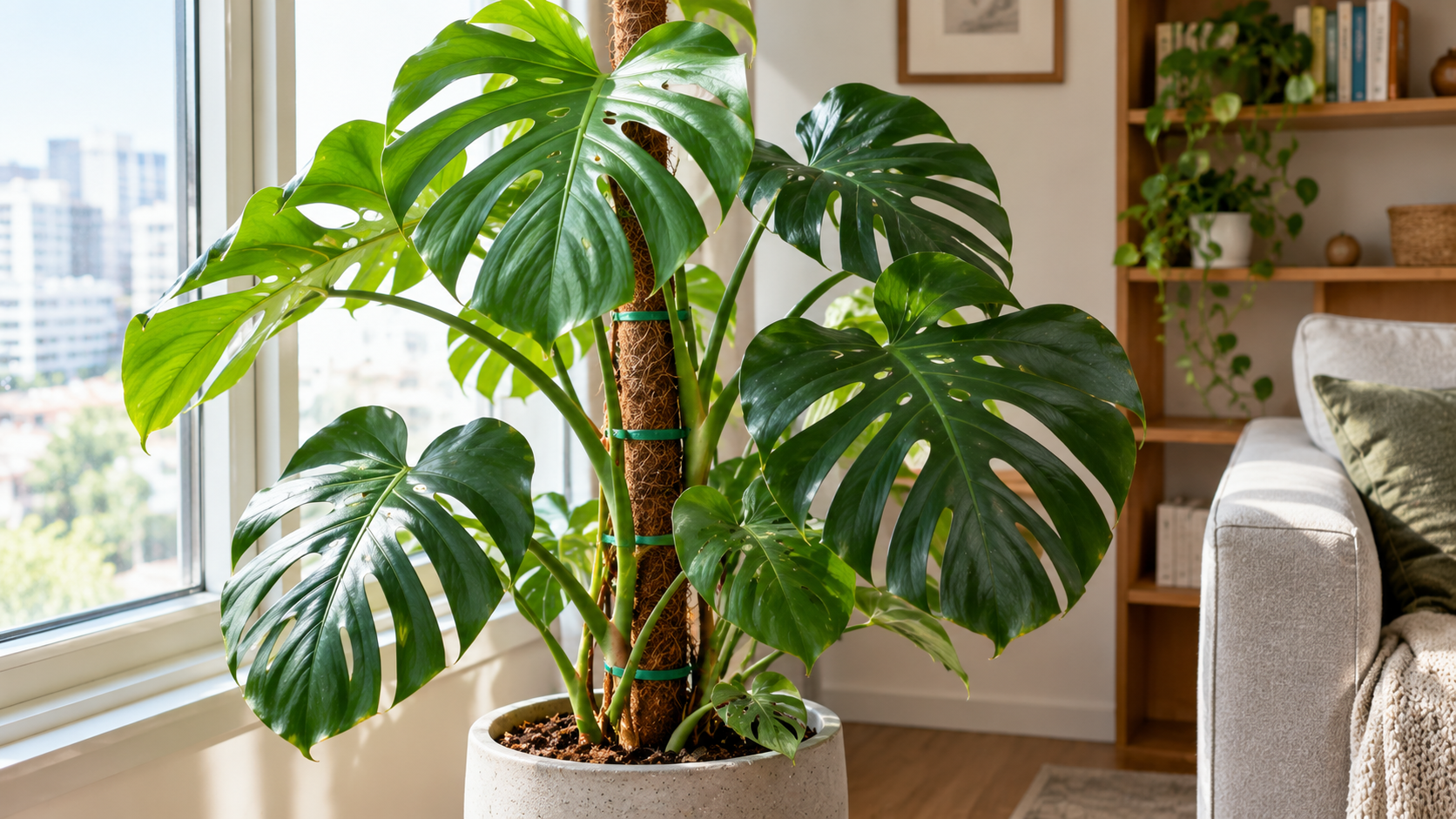
A Monstera deliciosa can transform an apartment corner into a lush, tropical-looking space, but its large leaves and climbing stems need more than an attractive pot. If the plant leans toward a window, develops long gaps between leaves, or begins to occupy more floor space than expected, its location and support may need adjusting.
The key is to understand how this plant grows in nature and adapt those conditions to your home. With suitable light, enough room, a stable support, and a thoughtful watering routine, you can guide your Monstera upward instead of letting it spread unpredictably across the room.
Understand How a Monstera Grows
Often called the Swiss cheese plant, Monstera deliciosa is a tropical climbing plant native to Central America. In its natural habitat, it can use trees and other structures to climb toward brighter conditions. Indoors, it may produce long stems, aerial roots, and increasingly large leaves as it matures.
Its familiar leaf holes and splits generally become more pronounced as the plant develops. Young leaves may be whole, so a plant with uncut leaves is not necessarily unhealthy or a different variety.
Understanding its climbing habit helps explain two important care decisions: where to place it and how to support it. A Monstera does not always grow as a compact, upright bush on its own. Without guidance, its stems may lean, trail, or spread sideways in search of light and something to attach to.
Where Should You Place a Monstera in an Apartment?
The best spot provides bright, indirect light, comfortable temperatures, and enough space for the leaves to expand. You should also be able to reach the pot easily for watering and occasional maintenance.
Choose a bright location without harsh sun
A position near a bright window is often a good starting point. A sheer curtain can soften strong sunlight, particularly during the hottest part of the day. Gentle morning sun may be tolerated in some homes, but intense direct sunlight through glass can scorch leaves, especially if the plant has not gradually adapted to it.
Watch the plant rather than judging a location by the window alone. Signs that it may need more light include:
- New growth that is smaller or less developed than expected.
- Long sections of stem between leaves.
- Stems that consistently lean toward the window.
- Slow growth during a period when the plant would normally be active.
Brown, bleached, or crispy patches on the side facing the window may indicate sun damage, although watering problems and other stressors can cause similar symptoms.
If your apartment has limited natural light, consider a suitable grow light rather than placing the plant in a dark corner and expecting it to thrive. Artificial lighting should be positioned and operated according to the manufacturer’s instructions.
Leave room around the leaves
Monstera leaves can become broad and extend outward from their stems. Avoid squeezing the plant between furniture, curtains, and walls, where leaves may be bent or repeatedly damaged.
Choose a location that allows the foliage to spread naturally without blocking a walkway. If space is limited, a sturdy climbing support can help direct growth upward, although it cannot eliminate the plant’s need for some horizontal room.
Avoid cold drafts and sudden environmental changes
Keep the plant away from frequent cold drafts, air-conditioning outlets, and heating vents that create rapid temperature or humidity changes. Normal household conditions are often suitable, but tropical foliage can respond poorly to cold exposure or repeated drying from warm air.
If you move the plant from a shaded room to a much brighter position, make the change gradually. A sudden increase in direct sunlight can damage leaves that developed under lower light levels.
How to Guide Your Monstera to Grow Upward
Monstera is a climber, so giving it a stable support can make its growth easier to manage in an apartment. Suitable options include a moss pole, a sturdy coir pole, a wooden board, or a strong plant trellis. Choose a support that can handle the weight of the mature plant rather than one that is only adequate for its current size.
Attach the stem, not the leaf stalks
The main stem is the part you want to guide along the support. Leaf stalks, called petioles, connect individual leaves to the stem and need to move toward the light. Tying these tightly against a pole can restrict their natural movement or damage the plant.
Use soft plant ties, garden Velcro, or strips of soft fabric to secure the stem loosely. Leave room for the stem to thicken. Never pull a bent stem into position if it resists; guide it gradually instead.
Understand aerial roots
Monstera often produces thick aerial roots along its stems. In nature, these roots help the plant attach to surfaces and access moisture. Indoors, they may extend into the air, toward the support, or over the side of the pot.
You can gently guide aerial roots toward a suitable support or the growing medium if they can reach without being forced. They do not all need to be tucked away. Avoid cutting them simply because they look unusual; remove one only when there is a practical reason, using clean tools.
When to add a support
Install a support when the plant begins to lean, its stems become difficult to manage, or you want to establish an upward growth direction. Adding support while the stems are still flexible is usually easier than trying to reposition a large, established plant later.
If the plant is already heavy or unstable, check whether the pot is large and sturdy enough to prevent tipping. A heavier pot can help, but it must still have drainage holes and an appropriate growing medium.
Watering and Soil: Keep the Roots Healthy
The right location helps, but the plant also needs a growing medium that holds moisture without remaining saturated. Use a well-draining potting mix designed for houseplants, ideally with enough coarse material to maintain air spaces around the roots.
Water thoroughly when the upper portion of the mix has dried, then let excess water drain completely. The exact interval depends on pot size, temperature, light, humidity, and the season. A Monstera near a bright window may use water faster than one in a cooler, dimmer room.
Before watering, check the mix with your finger rather than relying on a calendar. If the surface is dry but the lower portion remains wet, wait and reassess. A pot without drainage holes makes moisture management more difficult and increases the risk of root damage.
How to Keep Your Monstera Manageable in a Small Apartment
A Monstera can become large, but you can influence how it occupies the available space. The goal is to guide healthy growth, not to force the plant into a shape that restricts its leaves.
Rotate the pot when needed
If the plant consistently leans toward the window, rotate the pot a little at a time so different sides receive light. Avoid frequent, dramatic changes in orientation if the plant is already adjusting to a new location.
Prune selectively
Remove yellow or badly damaged leaves with clean cutting tools. If the plant has outgrown its space, you can shorten an overly long stem by cutting just above a node, provided the remaining plant retains healthy growth points and foliage.
Pruning does not replace adequate light. If new stems are unusually stretched, first assess the location before cutting healthy growth.
Repot when the plant needs it
Repotting may be appropriate when roots crowd the container, water runs through unusually quickly because the mix has broken down, or growth becomes difficult to maintain. Choose a pot only moderately larger than the current root ball, with drainage holes. An oversized pot can retain moisture for too long around a relatively small root system.
Common Problems and What They May Mean
Several visible changes can help you decide whether the plant needs a different location or a change in care.
| What you notice | Possible explanation | What to check |
|---|---|---|
| Long stems with wide gaps between leaves | Insufficient light or growth habit | Light levels and distance from the window |
| Pale or scorched patches | Excessive direct sunlight or other stress | Recent moves and sun exposure |
| Yellowing leaves with persistently wet soil | Overwatering, poor drainage, or root stress | Moisture below the surface and drainage holes |
| Brown, crispy edges | Low humidity, irregular watering, or salt buildup | Indoor conditions and watering history |
| Plant leaning or tipping | Lack of support or an unstable pot | Stem attachment and container weight |
Do not diagnose a problem from one symptom alone. For example, a yellow leaf may be an older leaf reaching the end of its life, but widespread yellowing combined with wet soil deserves closer inspection. Make one reasonable adjustment at a time and observe the response.
Safety Considerations for Homes With Pets and Children
Monstera deliciosa contains insoluble calcium oxalate crystals that can irritate the mouth and digestive tract if chewed or swallowed. Keep the plant out of reach of children and pets who may nibble its leaves, and wear gloves if your skin is sensitive when pruning or handling damaged stems.
If a pet chews the plant and develops drooling, mouth irritation, vomiting, or difficulty swallowing, contact a veterinarian promptly. Seek urgent help if breathing or swallowing is impaired. You can find additional information from the ASPCA’s Monstera deliciosa safety guidance.
Frequently Asked Questions
Can a Monstera live far from a window?
It may survive in lower light, but growth is often slower and stems may become stretched. If natural light is limited, move it to a brighter indirect-light location or consider an appropriate grow light.
Does a Monstera need a moss pole?
Not necessarily, but a sturdy support helps guide its climbing habit and can make a large plant easier to manage. A trellis or suitable board may also work.
Why are my Monstera’s leaves not splitting?
Young leaves often develop without the characteristic holes and splits. Leaf development also depends on maturity and growing conditions, including adequate light. Do not assume that every unsplit leaf indicates a problem.
Should I mist the leaves every day?
Daily misting is not necessary for most apartments and does not reliably maintain higher humidity for long. Focus instead on appropriate watering, good growing conditions, and avoiding excessively dry air from heating or air-conditioning.
Build a Routine Around Your Plant’s Growth
Start by choosing the brightest comfortable spot available, then provide a stable support before the stems become difficult to manage. Keep the roots in a well-draining mix, check moisture before watering, and adjust the plant’s position gradually if it shows signs of stretching or sun stress.
A Monstera will change as it matures, so its ideal arrangement may need occasional updates. Observe new leaves, stem direction, and how quickly the soil dries before making further changes. This approach helps the plant grow in a way that suits both its natural climbing habit and the practical limits of apartment living.