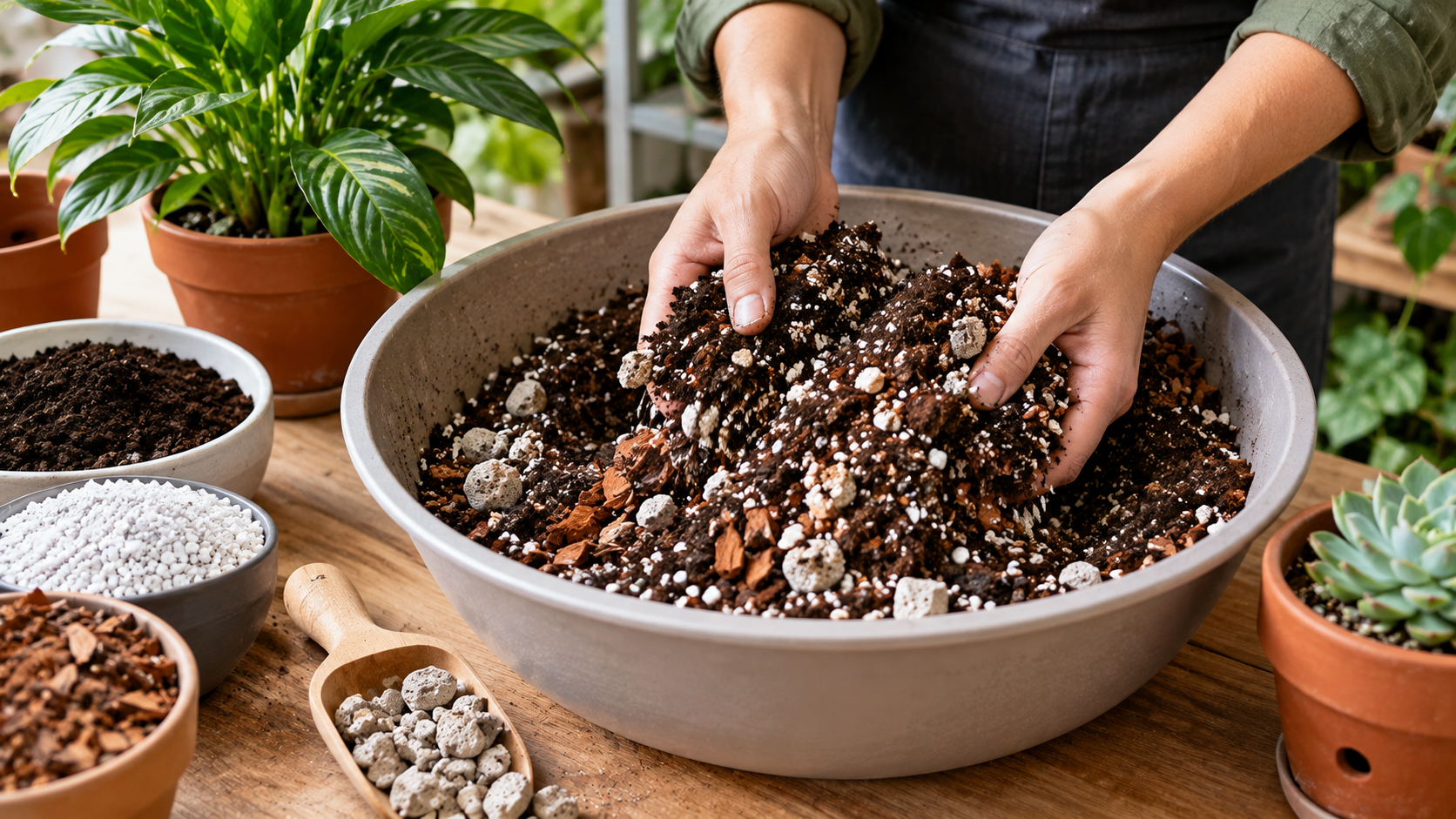
If your houseplants frequently develop yellow leaves, wilt despite regular watering, or sit in damp soil for days, the problem may be related to the potting mix. Some growing media retain too much water, leaving roots with insufficient oxygen and increasing the risk of root damage.
Preparing a lightweight potting mix can help create a better balance between moisture retention, drainage, and airflow around the roots. However, the best mixture depends on the plant. A cactus needs different conditions from a tropical foliage plant, even though both can suffer when their roots remain saturated.
The goal is not to make the soil dry out as quickly as possible. It is to create a growing medium that holds enough water for the plant to use while allowing excess moisture to drain and air to return to the root zone.
Why Do Some Plants Need a Lightweight Potting Mix?
Plant roots need both water and oxygen. When the spaces between particles remain filled with water for too long, oxygen becomes less available, making it harder for roots to function properly.
A dense, compacted growing medium can aggravate this problem. Fine particles may settle together, drainage can slow, and the root zone may remain wet long after the plant has received enough water.
A lightweight potting mix helps by combining materials with different physical properties. Some ingredients retain moisture, while others create larger pores that improve aeration and drainage.
A suitable mixture can offer several benefits:
- Better root aeration: Air-filled spaces help roots access oxygen.
- More predictable watering: A well-structured mix can drain excess water while retaining useful moisture.
- Reduced compaction: Coarser ingredients can help maintain a stable structure.
- Healthier root development: Appropriate moisture and oxygen conditions support normal root function.
Lightweight does not automatically mean well-draining. A mix made mostly of very fine peat or compost can be light when dry yet retain substantial water when saturated. The particle size, proportions, container, and plant species all influence how the medium behaves.
Which Materials Should You Use?
You do not need every ingredient available at a garden center. Start with a suitable base and add amendments according to the needs of your plant.
1. Potting mix or coconut coir
A commercial potting mix provides the foundation for many indoor plants. Depending on its formulation, it may contain peat, coir, composted bark, perlite, or other components.
Coconut coir can retain moisture while contributing to a relatively open growing medium. However, its water retention depends on particle size and processing, and it should not be treated as a drainage material by itself.
Choose a clean, horticultural-grade product rather than ordinary garden soil. Garden soil may compact in containers and can introduce weed seeds or unwanted organisms.
2. Perlite
Perlite is a lightweight, porous material commonly used to increase air space in container mixes. It can help reduce compaction and improve drainage when incorporated appropriately.
It is especially useful when a standard potting mix stays wet longer than the plant’s needs justify.
Because perlite dust can irritate the respiratory tract, moisten it gently before handling and avoid inhaling airborne particles.
3. Pumice
Pumice is a porous mineral material that can improve the physical structure of a potting mix. It is useful for many succulents and cacti, particularly when a stable, mineral-rich component is desirable.
Compared with some very lightweight amendments, pumice is heavier, so it may provide more stability for tall plants or containers that tip easily.
4. Pine bark
Small pieces of horticultural pine bark can create larger air spaces and help maintain structure. Bark is particularly useful in mixes for many epiphytic plants and tropical houseplants that prefer a loose, airy root environment.
Use appropriately sized, composted horticultural bark. Large chunks may leave too many gaps for small roots, while very fine material may hold more moisture than expected.
5. Compost
Compost can contribute nutrients and improve water retention, but it is not essential in every container mix. Too much fine compost can make a medium denser and wetter, especially in a small pot with limited drainage.
For plants that require a fast-draining substrate, use compost sparingly or choose a formulated potting mix that already contains appropriate nutrients.
Avoid using ordinary sand as a universal drainage solution. Fine sand can fill the gaps between larger particles and make some mixtures denser. If you use mineral amendments, choose materials and particle sizes appropriate for container cultivation.
Two Practical Recipes for a Lightweight Potting Mix
The following recipes are starting points, not universal formulas. Measure ingredients by volume using the same container for each component, and adjust the proportions to the plant’s needs and your growing conditions.
Recipe 1: For tropical foliage plants

2 parts quality potting mix
Provides moisture retention and a base for root growth.

1 part perlite
Adds lightweight particles that help maintain air space.

1 part fine horticultural bark
Improves structure and creates a looser root environment.
This blend may suit plants such as pothos, philodendrons, and some monstera varieties, provided the ingredients are appropriately sized and the plant’s moisture requirements are considered.
If your home is very dry or the plant prefers consistently moist conditions, the mix may need more moisture-retentive material. If the pot remains wet for too long, increasing the proportion of coarse components may help.
Recipe 2: For cacti and many succulents

1 part cactus potting mix
Provides a base that may retain some usable moisture.

1 part pumice or coarse perlite
Increases the proportion of coarse, aerating material.
This more mineral-oriented blend is a starting point for many desert cacti and succulents. Some species need even faster drainage, while others tolerate or prefer greater moisture retention. Species-specific growing guidance should take priority over a generic recipe.
Do not automatically use this mixture for tropical or forest-growing succulents, such as holiday cacti, whose moisture requirements differ from those of desert species.
How to Prepare and Use the Mix Step by Step
Before mixing, gather your ingredients, a clean container for blending, a scoop, gloves if desired, and a plant pot with drainage holes.
- Measure the ingredients. Use the same scoop or cup for each part to maintain the intended proportions.
- Dampen dusty materials lightly. Add a little water to the mix while blending until it is evenly moist but not soggy. Avoid breathing in dust from dry perlite or other fine materials.
- Combine thoroughly. Break up compacted clumps without crushing coarse particles. The finished mixture should have a loose, reasonably uniform structure.
- Prepare the pot. Ensure drainage holes are open. A mesh screen can help keep large particles from escaping, but avoid blocking water flow.
- Position the plant. Remove it gently from its old container and inspect the roots if the symptoms justify doing so.
- Fill around the root ball. Add the new mix without compressing it tightly. Leave a little space at the top for watering.
- Water according to the species. Water thoroughly when appropriate and let excess water drain away. Do not leave the pot standing in collected water.
Choose a pot only moderately larger than the root ball. Excessive container space can hold more water than a small root system can use, prolonging wet conditions.
A new mix may behave differently from the old one, so check moisture more frequently during the first few weeks.
How to Tell Whether Your New Substrate Is Working
A lightweight mix should support healthy roots without remaining saturated for an unnecessarily long period. You can evaluate its performance through a few simple observations.
Check drainage after watering
Water should move through the mix rather than pooling on the surface for an extended period. Some water retention is normal, and a few seconds of drainage does not necessarily mean the mix is ideal.
If water runs straight through while the interior remains dry, the medium may be difficult to rewet or contain too many coarse particles. Moisten it evenly and check whether the root ball actually receives water.
Monitor how quickly the pot dries
There is no universal drying time for a healthy potting mix. Temperature, light, humidity, pot material, plant size, and species all affect moisture loss.
If the substrate stays saturated and the plant develops yellow leaves, investigate drainage and watering frequency. If it dries extremely quickly and the plant repeatedly wilts, consider adding a little more moisture-retentive material.
Inspect root health when necessary
Healthy roots vary in color by species, but they are generally firm rather than mushy. Soft, dark roots that deteriorate easily can indicate root damage, especially when combined with persistently wet soil.
If root rot is suspected, remove the plant carefully, assess the roots, and remove clearly dead tissue with clean tools when appropriate. Repot into a suitable fresh mix and a clean container with drainage holes.
Common Mistakes When Making Lightweight Potting Mix
Avoid these common errors when preparing a substrate:
- Adding too much perlite or bark: The mix may dry too quickly for plants that need consistent moisture.
- Using only coarse material: Roots may struggle to access sufficient moisture and nutrients, depending on the species.
- Packing the substrate tightly: Compression reduces air spaces and can interfere with drainage.
- Adding gravel to the bottom of the pot: A gravel layer does not reliably improve drainage through the growing medium and can leave saturated soil above it.
- Using garden soil alone: It often compacts in containers and may introduce unwanted organisms.
- Ignoring fertilizer requirements: Some soilless potting mixes contain few nutrients, so plants may eventually need an appropriate fertilizer.
- Reusing contaminated materials: Old substrate from plants with root disease or serious pest problems may introduce further difficulties.
Keep in mind that changing the substrate will not compensate for every watering problem. A well-draining mix can still become waterlogged if the plant receives excessive water or sits in a full saucer.
Frequently Asked Questions
Can I make a lightweight potting mix without perlite?
Yes. Depending on the plant, pumice or appropriately sized horticultural bark may help create a well-aerated mix. Choose ingredients based on their properties and the plant’s needs rather than assuming one material is essential.
Is coconut coir better than peat moss?
Neither is universally better. Both can retain moisture, but their characteristics depend on processing, particle size, and the overall formulation. Consider water retention, product quality, and sustainability preferences when choosing between them.
Should every indoor plant have fast-draining soil?
No. Desert cacti and many succulents generally need a more mineral, fast-draining medium than plants that naturally grow in consistently moist environments. Many tropical foliage plants benefit from a mix that retains some moisture while providing good aeration.
Do I need to fertilize a homemade substrate?
Possibly. Many soilless ingredients provide little nutrition, although some commercial potting mixes include fertilizer. Check the ingredients and follow a feeding routine suited to the plant, avoiding excessive fertilizer.
How often should I replace the potting mix?
There is no fixed replacement interval for every plant. Consider repotting when the mix has broken down, drainage has deteriorated, salts have accumulated, or the plant has outgrown its container. Healthy plants do not necessarily need frequent repotting.
Build a Substrate Around Your Plant’s Needs
A good lightweight potting mix balances three essentials: water retention, drainage, and oxygen around the roots. The right proportions depend on the species, container, and environment, so begin with a suitable recipe and adjust only when observations indicate a need.
Before changing the substrate, check whether the problem actually comes from compacted soil, poor drainage, excessive watering, or an oversized pot. Addressing the underlying cause will make your efforts more effective and help create a healthier root environment over time.