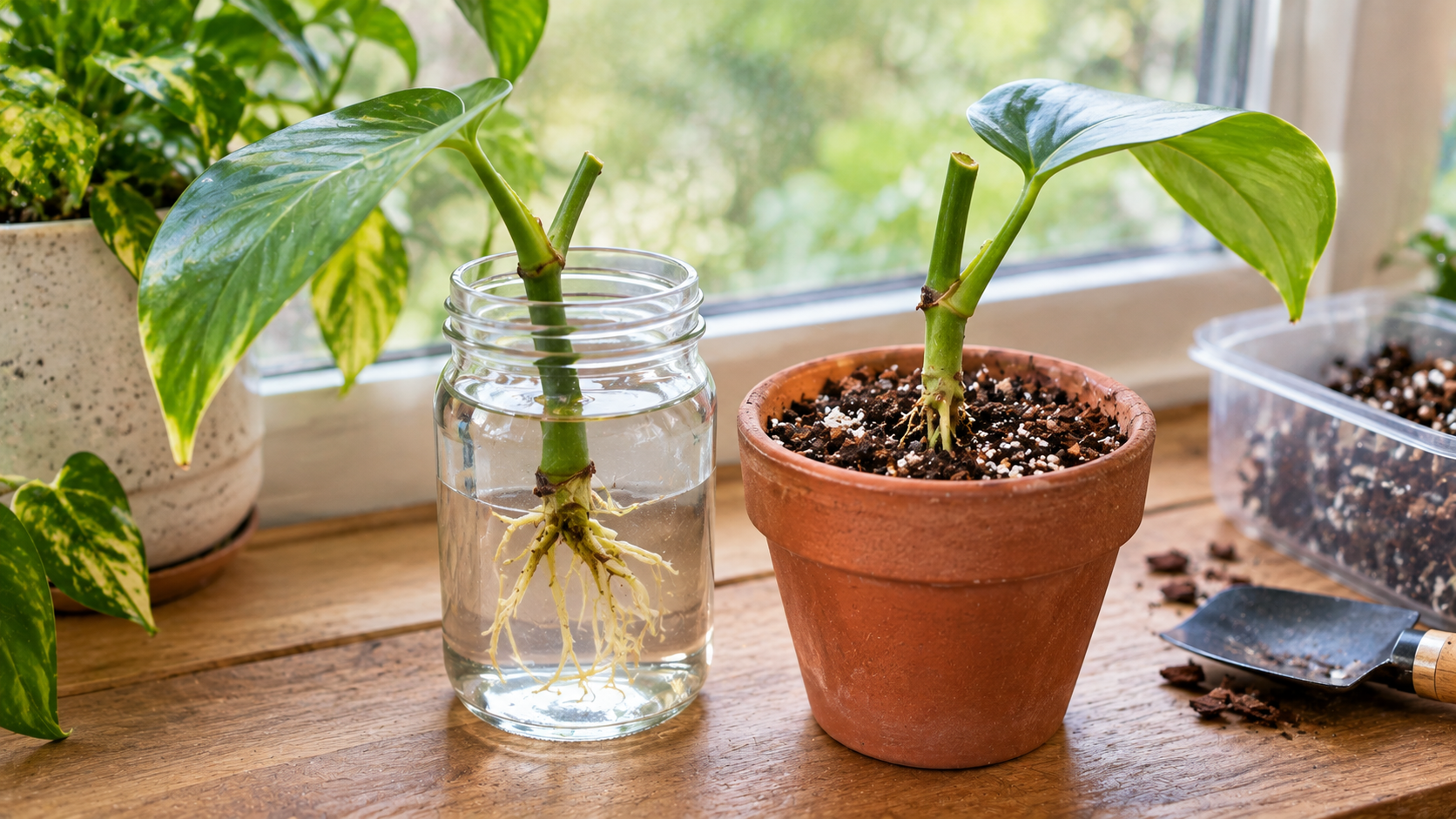
You place a plant cutting in water or potting mix, wait patiently, and eventually notice healthy-looking roots. Yet weeks later, there are still no new leaves. The cutting seems alive, but it does not appear to be turning into a new plant.
This situation is common in home propagation, and it does not always mean you have done something wrong. Developing roots and producing new shoots are separate stages of plant growth, and some cuttings can form roots without having the structures or resources needed to produce leaves.
The reason may be the type of cutting, the plant species, insufficient light, unsuitable temperatures, or a lack of a viable growth bud. Understanding these differences helps you decide whether to wait, adjust the growing conditions, or start again with a more suitable cutting.
1. Why Roots Can Grow Before New Leaves Appear
When a cutting is separated from its parent plant, it must survive without the original root system. Depending on the species, it may develop new roots from stem or leaf tissue. These are called adventitious roots.
Roots help the cutting absorb water and nutrients, but they do not automatically create new stems or leaves. For new shoots to appear, the cutting must also have the ability to produce buds or initiate new shoot growth.
In a stem cutting, existing buds may be located at nodes—the points where leaves attach to the stem or where branches can emerge. In some leaf cuttings, new shoots can develop from specialized tissues, but this ability is not shared by all plants.
For example, African violets can often be propagated from leaf cuttings that eventually produce young plants. By contrast, a leaf from many other species may form roots but never develop into a complete plant.
The first question to ask is whether your particular cutting is capable of producing new shoots. If it is not, improving light, watering, or fertilizer will not solve the underlying problem.
2. The Most Common Reasons Cuttings Develop Roots but No Leaves
The cutting does not contain a viable growth bud
This is one of the most important causes to consider.
Many stem cuttings need at least one suitable node or bud to produce a new shoot. A piece of stem without a viable growth point may form roots but fail to develop leaves.
Leaf cuttings have different requirements. Some species can produce both roots and shoots from a leaf, while others need a section of stem or a leaf-bud cutting.
Before propagating a plant, check whether the recommended method uses:
- Stem tips containing one or more nodes.
- Stem sections with viable buds.
- Leaves or leaf sections capable of producing shoots.
- Divisions, offsets, or other specialized plant structures.
If your cutting lacks the necessary growth structure, taking a new cutting using the correct method is often more effective than waiting indefinitely.
The plant is naturally slow to produce shoots
Root formation does not follow the same timetable in every species. Some soft, actively growing stem cuttings may root relatively quickly, while woody plants and certain houseplants can take much longer.
Even after roots appear, the cutting may need additional time to establish a functional root system and develop new growth. Rooting time also varies with the age of the plant material, temperature, light, and growing medium.
A few visible roots do not necessarily mean the cutting is ready to produce leaves immediately. If the stem remains firm, the cutting is suited to the propagation method, and conditions are stable, patience may be the best option.
Insufficient light slows shoot development
Cuttings need suitable light to support growth. Once leaves are present, photosynthesis helps supply energy for root and shoot development. A cutting with few or no leaves relies more heavily on stored resources in its tissues.
If a rooted cutting is kept in a dim corner, it may remain alive but grow slowly. New shoots may take longer to emerge, especially when the plant is already under stress.
Move the cutting to a bright location with indirect light if that suits the species. Avoid suddenly exposing a cutting grown in shade to intense direct sunlight, which can cause overheating or leaf damage.
Temperature is unsuitable
Many plants root and produce shoots more readily within a suitable temperature range for their species. Cool conditions can slow growth, while excessive heat can increase water loss and stress the cutting.
A cutting on a cold windowsill may grow slowly even if it receives good light. Conversely, a covered propagation container placed in strong sun can become too hot.
Keep the cutting in a stable environment appropriate for the plant. Avoid placing it directly beside heating vents, cold drafts, or surfaces that become very hot during the day.
Excess moisture or poor aeration damages the roots
Roots need both moisture and oxygen. If a cutting sits in waterlogged soil, the lack of air can damage its roots and encourage rot. The cutting may initially develop roots, then stop growing as those roots deteriorate.
Signs of a possible problem include:
- Roots that become brown, mushy, or unpleasant-smelling.
- A stem base that turns dark or soft.
- Potting mix that remains saturated for an unusually long time.
- A cutting that declines despite having visible roots.
Use a clean container and a propagation medium that retains some moisture without becoming waterlogged. If rot is evident, remove damaged tissue with a clean tool and reassess whether the remaining cutting is healthy enough to continue.
The cutting lacks enough stored energy
A cutting uses stored carbohydrates and, when it has leaves, energy produced through photosynthesis to support new growth. Very small, weak, damaged, or immature cuttings may have limited reserves.
A cutting can sometimes produce roots using its remaining resources without having enough capacity to sustain further development. This is one reason healthy parent plants and appropriately sized cuttings generally offer better starting conditions.
Choose firm, healthy material and follow the propagation method recommended for the species. Do not remove every healthy leaf from a stem cutting unless the technique specifically requires it; leaves can contribute to energy production, although excessive foliage can also increase water loss.
3. How to Encourage New Leaves Without Damaging the Cutting
Before changing anything, assess the cutting’s condition. If it has firm tissue, healthy roots, and no signs of rot, avoid disturbing it unnecessarily.
Use the following steps to improve its chances of producing shoots.
- Confirm the propagation method. Check whether the species can grow into a complete plant from the type of cutting you have. If it needs a node or bud, make sure one is present.
- Provide suitable light. Place the cutting in bright, indirect light when appropriate for the species. Avoid intense direct sunlight, especially inside a covered propagation container.
- Maintain an appropriate temperature. Keep conditions stable and within the plant’s preferred range. Avoid cold drafts and excessive heat.
- Check moisture before watering. Keep the rooting medium appropriately moist for the species, not constantly saturated. Different plants have different requirements.
- Allow time for establishment. Root development and shoot emergence can be separated by weeks or, in some cases, longer. The appropriate waiting period depends on the species and conditions.
- Inspect without repeatedly pulling the cutting out. Tugging or unpotting it frequently can damage new roots. Observe the stem, leaves, and medium instead.
Do not automatically add fertilizer to force new leaves. A newly rooted cutting may be sensitive to concentrated nutrients, and fertilizer cannot compensate for missing buds, inadequate light, or damaged roots. Follow species-specific guidance and wait until the plant is sufficiently established before beginning a feeding routine.
4. Should You Keep a Cutting in Water or Move It to Soil?
Both methods can work, but the best choice depends on the plant and your growing conditions.
If the cutting is rooting in water
Keep the appropriate rooting portion submerged while preventing leaves from sitting underwater. Replace the water if it becomes cloudy or develops an unpleasant smell, and use a clean container.
Some cuttings form roots in water but take time to produce shoots. If the species is suitable for water propagation and the cutting remains firm, the absence of new leaves alone is not a reason to move it immediately.
When roots are sufficiently developed for the species, transfer the cutting carefully to a suitable potting medium if you intend to grow it in soil. Water-grown roots may need time to adjust to the new environment, so avoid allowing the soil to become completely dry immediately after planting.
If the cutting is already in soil
Check whether the medium is draining well and whether the cutting is planted at the correct depth. A stem cutting may need a node in contact with the rooting medium, while leaves or other plant parts may require different positioning.
Do not repot simply because new leaves have not appeared. If the medium is suitable and the cutting looks healthy, unnecessary disturbance may delay establishment.
5. Mistakes That Can Delay New Growth
Several well-intentioned actions can make propagation less successful.
- Overwatering: Constantly wet soil can deprive roots of oxygen and increase the risk of rot.
- Excessive direct sunlight: A cutting with limited roots may lose water faster than it can absorb it.
- Frequent repotting: Disturbing developing roots can interrupt establishment.
- Excess fertilizer: High nutrient concentrations may damage sensitive roots without solving the real problem.
- Changing several conditions at once: If light, water, temperature, and fertilizer are all changed simultaneously, it becomes difficult to identify which factor was responsible.
- Using the wrong plant part: Some leaves can root but cannot produce shoots, regardless of how carefully they are maintained.
A better approach is to make one justified adjustment, keep the conditions stable, and monitor the response.
6. When Should You Start Again With a New Cutting?
Waiting is reasonable when the cutting is firm, the roots look healthy, and the propagation technique is appropriate for the species.
Consider starting again if the stem becomes extensively soft or black, the roots deteriorate, or the cutting clearly lacks the structure needed to produce shoots. A fresh cutting should come from a healthy parent plant and include the plant parts required by the recommended method.
For some plants, division or separating an offset may be more reliable than propagating from a leaf or stem fragment. Selecting the appropriate technique can save time and reduce unnecessary losses.
Give Your Cutting the Right Conditions to Grow
Roots are an encouraging sign, but they are only one part of successful propagation. A cutting also needs the biological capacity to produce shoots, suitable environmental conditions, and enough time to establish itself.
Start by identifying the plant species and confirming that your cutting contains the necessary growth structures. Then check light, temperature, moisture, and root health before making changes. If the cutting is healthy and the method is correct, stable care is often more useful than repeated interven