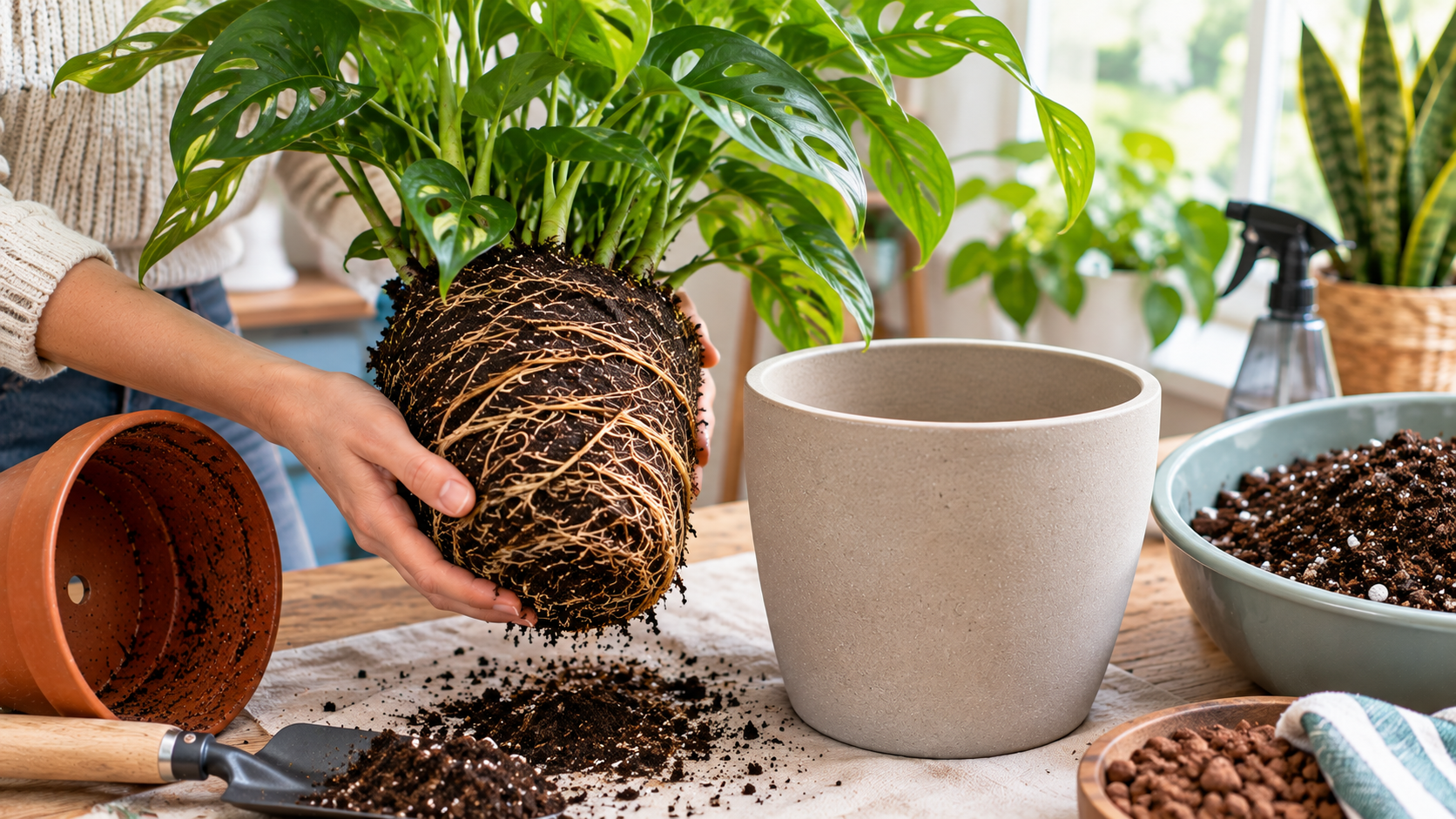
A plant can remain in the same pot for months or even years, but eventually its roots, growing medium, or overall growth may indicate that conditions need to change. Knowing when to repot a plant helps prevent root congestion, improves growing conditions, and gives the plant a better chance to develop healthy new leaves.
However, not every yellow leaf or slow-growing stem means a larger pot is necessary. Watering problems, insufficient light, pests, and unsuitable temperatures can cause similar symptoms. The key is to identify the underlying problem before disturbing the roots.
In this guide, you will learn how to recognize the signs that a plant needs repotting, choose the right container, perform the process safely, and care for your plant afterward.
1. Roots Are Growing Through the Drainage Holes

One of the clearest signs that a plant may need repotting is the appearance of roots through the drainage holes at the bottom of its container.
As a plant grows, its root system gradually occupies more space. When the available room becomes limited, roots may extend toward openings in search of additional space, moisture, and nutrients.
However, a single root emerging from a drainage hole does not automatically mean the plant needs a bigger pot. Some healthy plants naturally send roots toward these openings.
What to check:
- Are several roots emerging from the bottom?
- Does the root system form a dense mass?
- Does water run through the pot unusually quickly?
- Has the plant stopped growing despite receiving appropriate light and care?
If several signs occur together, inspect the root ball. A dense network of roots circling the sides and bottom is stronger evidence of congestion than one visible root.
2. Water Runs Through the Pot Too Quickly
If the growing medium dries out soon after watering, the roots may have occupied most of the available space, leaving little growing medium to retain moisture.
For example, a plant that previously remained adequately hydrated for several days may begin wilting much sooner under similar conditions. This can happen when the root ball has become densely packed.
Nevertheless, rapid drying is not proof that repotting is necessary. Hot weather, strong sunlight, low humidity, and a loose potting mix can also increase water loss.
Before changing the pot, check the following:
- Compare how quickly the soil dries under similar weather conditions.
- Check whether water is penetrating the root ball or running down the gap between the soil and pot.
- Consider whether the plant has recently received more sunlight or warmer temperatures.
- Inspect the roots if several signs of overcrowding are present.
If the root ball is densely packed, moving the plant into a slightly larger container may help. If the roots have sufficient space, improving the watering technique or growing medium may be enough.
3. Roots Appear on the Soil Surface
Roots emerging across the surface of the potting mix can indicate that the plant has outgrown its container. This is especially relevant when the surface roots are accompanied by dense roots underneath the root ball.
Some plants naturally produce aerial roots or grow close to the soil surface. These features are not necessarily signs of a problem.
Observe whether the plant has enough room to grow and whether the existing potting mix remains functional. If the soil has compacted or significantly broken down, refreshing the growing medium may be more useful than simply choosing a larger container.
4. New Leaves Are Smaller Than Usual
A plant that produces progressively smaller leaves may be experiencing restricted root growth or inadequate access to water and nutrients.
When roots fill the available space, the plant can struggle to maintain vigorous growth. However, smaller leaves can also result from insufficient light, nutrient deficiencies, pests, seasonal changes, or other environmental stress.
Compare recent growth with the plant’s previous healthy growth rather than judging a single leaf.
If the leaves are becoming smaller and the roots are densely packed, repotting may help. If the roots have sufficient room, review the plant’s light exposure, watering schedule, and fertilizer requirements first.
5. The Plant Wilts Between Waterings
Wilting is another symptom that deserves attention, particularly when it happens even though you are following an appropriate watering routine.
A crowded root system may leave the plant with insufficient accessible growing medium to retain the water it needs. In other situations, wilting occurs because the roots are damaged or the soil remains excessively wet.
These causes require different responses.
- Dry soil and tightly packed roots: The plant may need more root space.
- Wet soil and persistent wilting: Check for poor drainage or root rot before considering a larger pot.
- Wilting after a sudden temperature change: Environmental stress may be responsible.
- Wilting accompanied by pests or damaged leaves: Investigate other possible causes.
Do not automatically increase watering whenever a plant wilts. If the roots are rotting, additional water can make the problem worse.
6. The Potting Mix Has Deteriorated
Even when a plant has enough root space, its growing medium can become less suitable over time.
Organic ingredients gradually decompose, and the mix may settle or compact. This can reduce the air spaces around roots, affect drainage, and change how water is retained.
RHS Advice
+1
Look for these signs:
- The soil level has dropped noticeably.
- The surface has become compacted or crusted.
- Water no longer penetrates the medium evenly.
- The mix stays wet for much longer than expected.
- A persistent surface buildup appears and cannot be explained by ordinary soil particles.
A white crust may indicate accumulated mineral salts rather than deteriorated soil alone. In that case, investigate water quality and fertilizer use as well.
If the roots remain healthy and the plant has sufficient space, replacing some of the old potting mix may be enough. Repotting does not always require a larger container.
7. The Plant Has Become Top-Heavy or Unstable
A plant that repeatedly tips over, leans heavily, or becomes unstable may need a more suitable container.
This can happen when the foliage has grown substantially while the root system remains confined to a small pot. Tall plants can also become unstable when their containers are lightweight.
Before repotting, determine whether the problem is caused by restricted roots, uneven light, or simply an unsuitable container.
If the roots fill the existing pot, consider a slightly larger, heavier container with drainage holes. If the roots have enough space, a more stable pot or a support stake may solve the problem without disturbing the plant.
8. How to Tell Whether Repotting Is Really Necessary
The most reliable way to assess root congestion is to inspect the root ball carefully. This helps distinguish a plant that needs additional space from one suffering from an unrelated problem.
Follow these steps:
- Check the plant’s overall condition. Look at new growth, leaf color, watering needs, and stability.
- Remove the plant gently. Support the base of the plant and slide the container away from the root ball. Avoid pulling forcefully on delicate stems.
- Inspect the roots. Healthy roots are generally firm, although their natural color varies by species. Dense roots circling the bottom and sides can indicate that the plant is root-bound.
- Check for damage. Soft, mushy, dark roots or an unpleasant smell may indicate root rot. Investigate the cause rather than simply transferring the plant into a bigger pot.
- Choose the appropriate action. Use a larger pot if roots are congested, refresh the growing medium if it has deteriorated, or address watering and environmental problems if the roots have adequate space.
If the plant is healthy and the root ball comes out with plenty of loose growing medium around it, there may be no immediate need to repot.
9. When Is the Best Time to Repot a Plant?
For many houseplants, spring or early summer is a suitable time to repot because active growth helps the plant establish itself in the new container. However, the ideal timing depends on the species, local climate, and growing conditions.
RHS Advice
+1
In Brazil, seasons are reversed compared with the Northern Hemisphere. For many plants, spring begins in September, but indoor temperatures, light levels, and the plant’s natural growth cycle matter more than the calendar alone.
Consider these guidelines:
- Healthy plants with crowded roots: Repot when the plant is actively growing, if practical.
- Plants with root rot: Address the drainage or watering problem promptly, regardless of the season.
- Slow-growing plants: Check species-specific requirements before disturbing the roots.
- Plants that flower seasonally: Avoid unnecessary repotting during sensitive flowering periods when possible.
- Dormant or stressed plants: Postpone routine repotting until conditions are more favorable, unless immediate intervention is needed.
There is no universal rule that every plant must be repotted annually. Some need attention every year or two, while others can remain in the same container for several years.
RHS Advice
+1
10. How to Choose the Right New Pot
Choosing a container that is too large can create problems because the excess growing medium may stay wet for too long, increasing the risk of root damage.
RHS Advice
+1
For many houseplants, a pot approximately 1–2 inches (2.5–5 cm) wider than the current container is a sensible starting point. The exact size depends on the plant and its root ball.
Before purchasing a new pot, consider:
- Drainage: Choose a container with unobstructed drainage holes.
- Size: Allow room for root growth without surrounding a small root ball with excessive wet soil.
- Material: Terracotta dries more quickly than many glazed or plastic pots, which can be helpful for plants that prefer drier conditions.
- Growing medium: Use a mix suited to the plant, such as a well-draining blend for many succulents or a moisture-retentive but aerated mix for suitable tropical plants.
- Stability: Taller plants may benefit from a heavier container.
Avoid adding a layer of stones to the bottom as a substitute for drainage holes. Instead, use an appropriate growing medium and a container that allows excess water to escape.
11. How to Repot a Plant Without Damaging Its Roots
Once you have confirmed that repotting is appropriate, prepare the materials and work carefully.
Materials you will need
- A clean pot with drainage holes.
- Fresh potting mix suitable for the species.
- Clean scissors or pruning shears, if damaged roots need removal.
- A watering can.
- Gloves and a protective surface for the work area.
Step-by-step repotting procedure
- Prepare the new container. Make sure it is clean and has working drainage holes.
- Remove the plant carefully. Hold the root ball rather than pulling the plant by its stems.
- Loosen congested roots gently. Untangle circling roots where possible. Remove clearly dead or rotten roots with clean tools, avoiding unnecessary cutting of healthy roots.
- Add fresh growing medium. Place enough mix in the pot to position the root ball at approximately its original depth.
- Position the plant. Center it and fill the gaps around the roots. Do not bury the crown, stem base, or trunk more deeply than appropriate for the species.
- Settle the mix. Press lightly to remove large air pockets without compacting the soil excessively.
- Water appropriately. For most plants that tolerate thorough watering, water until excess moisture drains from the bottom. Follow species-specific guidance for plants that require a different approach.
The goal is to give the roots a suitable growing environment, not to disturb them more than necessary.
12. What to Do After Repotting
A newly repotted plant may need time to adjust. Some temporary loss of vigor can occur because the root system has been disturbed.
For the following weeks:
- Keep the plant in the light conditions appropriate for its species.
- Avoid sudden changes in temperature or exposure to intense direct sunlight if the plant is not adapted to it.
- Check soil moisture before watering instead of following a rigid schedule.
- Do not apply extra fertilizer immediately unless the plant’s specific requirements indicate otherwise.
- Watch for persistent wilting, yellowing, or soft stems that could indicate a problem.
Avoid repeatedly moving the plant or changing several care conditions at once. Doing so makes it harder to identify the cause if the plant begins to deteriorate.
If the growing medium remains soggy, check drainage and watering frequency. If the plant continues to wilt despite suitable moisture, inspect for possible root damage.
Frequently Asked Questions
How often should a plant be repotted?
There is no fixed schedule for every species. Many plants need repotting every few years, while fast-growing species may need it sooner. Root congestion, the condition of the growing medium, and the plant’s health are more useful indicators than age alone.
Can I repot a plant that is flowering?
It is generally preferable to avoid unnecessary disturbance during flowering, especially for sensitive plants. However, if the roots are rotting or the container has a serious drainage problem, addressing the issue may be more important than waiting until flowering ends.
Should I remove all the old soil when repotting?
No. Healthy roots do not usually need to be stripped of all their existing growing medium. Remove loose or deteriorated material when appropriate, and avoid aggressive cleaning unless a specific problem requires it.
Does every plant with roots coming out of the pot need a bigger container?
No. A few roots through drainage holes do not necessarily indicate serious congestion. Inspect the root ball and consider the plant’s growth, water requirements, and overall condition before deciding.
Make the Decision by Reading the Plant’s Signs
Repotting is most effective when it addresses a genuine need. Roots densely circling the container, unusually rapid drying, reduced growth, and deteriorating potting mix can all justify closer inspection, but no single symptom should be interpreted without considering the plant’s environment.
Start by checking the roots, drainage, and growing medium. Then choose the least disruptive solution that meets the plant’s needs. With a suitable pot, appropriate soil, and careful aftercare, you can help your plant continue growing without exposing it to unnecessary stress.