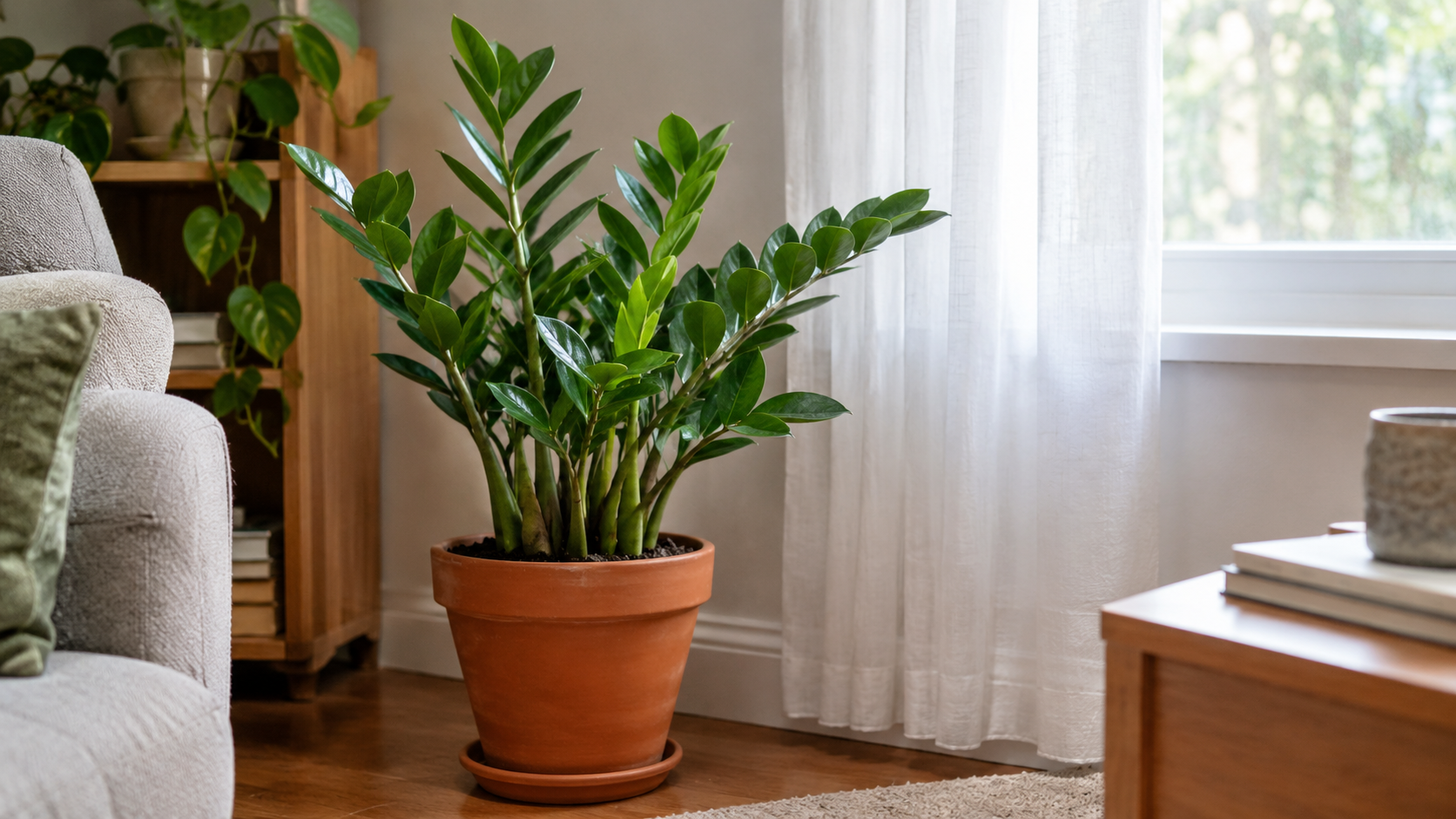
A room with small windows, a shaded corner, or an office far from direct sunlight can make growing houseplants challenging. Fortunately, the ZZ plant (Zamioculcas zamiifolia) is one of the most adaptable indoor plants for these conditions. Its glossy green leaves, upright growth, and water-storing underground rhizomes allow it to tolerate lower light levels and occasional missed waterings.
However, tolerating low light does not mean thriving without light. A ZZ plant in a dim room usually grows more slowly, needs less frequent watering, and may produce fewer new shoots than one receiving bright, indirect light.
Understanding how light affects watering, growth, soil moisture, and plant health will help you keep your ZZ plant attractive without unnecessary maintenance. This guide explains how to choose the right location, establish a safe watering routine, recognize common problems, and decide when additional lighting may be necessary.
1. Can a ZZ Plant Survive in Low Natural Light?
Yes. The ZZ plant is well suited to indoor environments where natural light is limited. Horticultural guidance from university extension services recognizes its ability to tolerate low-light conditions, making it a practical choice for homes and offices.
Its resilience comes partly from its thick, underground rhizomes, which store water and help the plant survive dry periods. Its relatively slow growth also means it does not demand the same level of resources as many fast-growing tropical houseplants.
Nevertheless, there is an important distinction between a low-light room and a room with virtually no usable light.
- Low natural light: A room receives daylight, but the plant is several feet from a window or positioned away from direct sunlight.
- Very low light: The room has a small window, limited daylight, or a shaded interior position.
- No natural light: A windowless room depends entirely on artificial illumination.
A ZZ plant may survive for extended periods in very dim conditions, but growth can become extremely slow. In a windowless office, suitable artificial lighting can help maintain the plant.
If the plant remains in darkness for most of the day, moving it closer to a window or providing a grow light is preferable to expecting it to remain healthy indefinitely without adequate illumination.
2. Choose the Best Location for Your ZZ Plant
The right location makes caring for a ZZ plant much easier. Although the species tolerates shade, bright, indirect light generally supports better growth.
Where should you place it?
Look for a position that receives daylight without exposing the leaves to intense, prolonged direct sunshine.
Suitable locations include:
- A living room several feet from a bright window.
- A bedroom with filtered daylight through curtains.
- A home office with a window nearby.
- A hallway that receives meaningful reflected daylight.
- A shaded corner of a naturally bright room.
The best distance from a window depends on its size, orientation, outdoor obstructions, curtains, and the amount of daylight entering the room. Instead of relying on a fixed distance, observe how bright the location remains during the day.
A plant beside a north-facing window may receive less light than one near an unobstructed east-facing window. In the Southern Hemisphere, including much of Brazil, north-facing windows often receive stronger sunlight, so the potential for direct sun exposure should also be considered.
How can you tell whether the spot is too dark?
Watch the plant over several weeks rather than judging it after a single day.
Possible warning signs include very slow or absent new growth during the growing season, increasingly sparse foliage, and stems that gradually lean toward a light source. These symptoms are not definitive proof of insufficient light, since temperature, watering, and the plant’s natural growth cycle also influence development.
If the plant appears healthy but produces few new shoots, it may simply be growing at its normal slow pace. If its condition deteriorates, reassess both the lighting and the soil moisture before making changes.
3. Water Less Frequently in Low-Light Conditions
Watering is one of the most important parts of ZZ plant care. In a dim room, the plant generally uses water more slowly because reduced light limits photosynthesis and growth. The potting mix may therefore remain moist for longer than it would near a brighter window.
The biggest risk is overwatering, which can deprive roots of oxygen and encourage rhizome rot.
How often should you water a ZZ plant?
There is no universal watering schedule. Some plants need water every couple of weeks during warm weather, while others in cool, dim rooms may go considerably longer between waterings.
Use soil moisture as your main guide:
- Check the potting mix with your finger or a wooden stick, including the deeper portion of the root zone where practical.
- If the mix is still damp, wait and check again later.
- When the mix has dried thoroughly, water the plant evenly until excess water drains through the bottom.
- Empty the saucer or decorative outer pot so the roots do not remain in standing water.
- Check the soil again before the next watering rather than following a fixed calendar.
A small plant in a large pot may need particular attention because excess soil can retain moisture for a long time. Likewise, plastic pots and dense potting mixes often dry more slowly than terracotta pots and airy mixes.
Should you water less in winter?
Usually, yes. During cooler months, indoor growth often slows, particularly when daylight levels decrease. Watering intervals may become longer, but the actual decision should still depend on soil dryness, room temperature, and pot drainage.
Do not water merely because a certain number of days has passed. A dry-looking surface can conceal moisture deeper in the pot.
4. Use Well-Draining Soil and a Suitable Pot
Even a naturally resilient plant can develop problems if its roots remain wet. The combination of low light, frequent watering, and poorly draining soil is especially unfavorable.
What potting mix works best?
Choose a loose indoor potting mix that drains readily and does not remain saturated for long periods. A commercial houseplant mix improved with perlite or fine orchid bark can provide better aeration, depending on the starting mix.
The goal is to retain enough moisture for the roots while allowing excess water to escape. Extremely compact garden soil is generally unsuitable for indoor containers because it may become dense and poorly aerated.
Does the pot need drainage holes?
Yes. A pot with drainage holes allows excess water to escape and makes watering easier to manage.
If you prefer a decorative pot without holes, keep the plant in a separate nursery pot with drainage and remove it for watering. Let it drain completely before returning it to the outer container.
Avoid choosing an excessively large pot when repotting. A much larger volume of soil can remain wet longer than the plant’s root system can use effectively. Repot when the roots or rhizomes have substantially filled the existing container, preferably into a pot only modestly larger.
5. Temperature, Humidity, and Air Circulation
ZZ plants adapt well to typical indoor conditions and do not usually require a humidifier.
For reliable growth:
- Keep the plant in a comfortably warm room, ideally around 18–26°C.
- Protect it from cold drafts and prolonged exposure to temperatures below approximately 15°C.
- Avoid placing it directly beside heating vents or air conditioners.
- Maintain ordinary household humidity unless the environment is exceptionally dry.
Low light does not create a need for extra humidity. Misting the leaves is generally unnecessary and does not compensate for insufficient illumination.
Air circulation should be gentle rather than excessively windy. A stable indoor position is preferable to repeatedly moving the plant between contrasting temperatures and lighting conditions.
6. Fertilizing a ZZ Plant That Grows Slowly
ZZ plants are naturally slow growers, and low light can slow them further. Applying extra fertilizer will not solve a lighting problem or force healthy growth when the plant lacks sufficient energy.
During spring and summer, you can use a balanced liquid houseplant fertilizer at a reduced concentration, following the product label. One or two light applications during the growing season may be sufficient for a plant growing in low light.
Reduce or stop feeding when growth slows considerably in autumn and winter.
Avoid fertilizing when the soil is extremely dry, when the roots may be damaged, or when the plant shows signs of rot. Excess fertilizer can contribute to salt accumulation and root stress.
If the plant looks healthy but has not produced a new shoot for several months, do not assume that it needs more nutrients. First consider its light exposure, season, and overall condition.
7. How to Identify and Fix Common ZZ Plant Problems
Changes in leaf color or stem firmness can reveal that something is wrong, but the same symptom can have several causes. Examine the soil, roots, lighting, and recent care routine before deciding what to do.
Yellow leaves
Yellowing can result from excessive watering, root or rhizome damage, natural aging, or other environmental stress.
What to do: Check whether the soil remains wet for prolonged periods. If it does, allow it to dry and review the drainage. If the stems are becoming soft or the plant has a foul smell, inspect the roots and rhizomes for rot.
A single older yellowing leaf does not necessarily indicate a serious problem. Widespread yellowing combined with persistently wet soil is more concerning.
Soft stems or rotting rhizomes
Healthy ZZ stems are generally firm. Soft, collapsing stems, darkened tissue, and a sour smell can indicate rot, particularly when the potting mix stays wet.
Remove the plant from its pot if rot is suspected. With clean tools, remove clearly rotten tissue and repot the remaining healthy portions in fresh, well-draining mix. If the damage is extensive, recovery may not be possible.
Do not respond to suspected rot by adding fertilizer or watering more frequently.
Brown leaf tips or patches
Brown areas may result from direct sun damage, inconsistent watering, root problems, or other stresses.
Check whether the plant receives strong afternoon sunshine, whether the soil dries excessively, and whether roots remain wet. Correct the likely cause before trimming damaged foliage.
Completely brown or damaged stems can be cut near the soil line with clean pruning shears. Healthy green leaves should generally be retained because they continue to support the plant.
No new growth
A ZZ plant may remain unchanged for months, particularly in low light or during cooler seasons. Slow growth alone is not necessarily a sign of poor health.
If the existing foliage remains firm and the roots appear healthy, maintain consistent care. If you want faster growth, gradually move the plant to a brighter location with indirect light rather than increasing watering or fertilizer indiscriminately.
8. When Should You Use Artificial Grow Lights?
Artificial lighting is worth considering when a room has little daylight, especially if the plant is losing vigor or you want to encourage new growth.
A suitable full-spectrum LED grow light can supplement natural light. Position it according to the manufacturer’s recommendations, taking into account the lamp’s intensity and coverage. Provide a consistent daily lighting period rather than leaving the lamp on continuously.
Ordinary room lighting may help somewhat, but its intensity and distance from the plant determine how useful it is. A lamp designed for growing plants is generally a more predictable option.
Introduce supplemental light gradually and monitor the foliage. If the plant has been kept in deep shade, avoid abruptly exposing it to intense light that could scorch its leaves.
9. Common Mistakes to Avoid
Preventing problems is usually easier than correcting them later. Avoid these frequent mistakes:
- Watering on a fixed schedule: Check the soil instead of watering every Sunday or every two weeks regardless of conditions.
- Keeping the plant in a completely dark corner: Shade tolerance is not the same as an absence of light.
- Using a pot without drainage: Trapped water increases the risk of root damage.
- Overfertilizing to encourage growth: Nutrients cannot replace adequate light.
- Repotting too frequently: Disturbing healthy roots unnecessarily can add stress.
- Ignoring household safety: ZZ plants are harmful if eaten and may irritate skin or eyes. Keep them away from children and pets that might chew them, and wear gloves when handling damaged plant tissue.
Frequently Asked Questions
Can a ZZ plant grow in a room without windows?
It may persist under suitable artificial lighting, but a windowless room needs a reliable light source to support long-term plant health. A dedicated grow light is a practical option.
How long can a ZZ plant go without water?
Its water-storing rhizomes allow it to tolerate prolonged dry periods, but there is no safe universal maximum. Pot size, temperature, light, and plant condition all affect water use. Check the soil rather than deliberately leaving the plant dry for months.
Will a ZZ plant grow faster near a window?
Usually, provided the location supplies more useful indirect light without excessive direct sun. Growth may still be slow because this species naturally develops gradually.
Should I rotate my ZZ plant?
Yes, occasional rotation can help maintain more even growth when light comes mainly from one direction. Turn the pot a little every few weeks rather than repeatedly relocating the plant.
Keep Your ZZ Plant Healthy by Following Its Signals
A ZZ plant is an excellent choice for a home or office with limited natural light, but its success depends on balancing light exposure with careful watering. Place it where daylight is available, use a freely draining potting mix, and let the soil dry thoroughly between waterings.
Start by checking your plant’s current location and soil moisture. Make one change at a time, then observe the leaves, stems, and appearance of new growth over the following weeks. In low-light conditions, patience and restraint are often more useful than extra water or fertilizer.