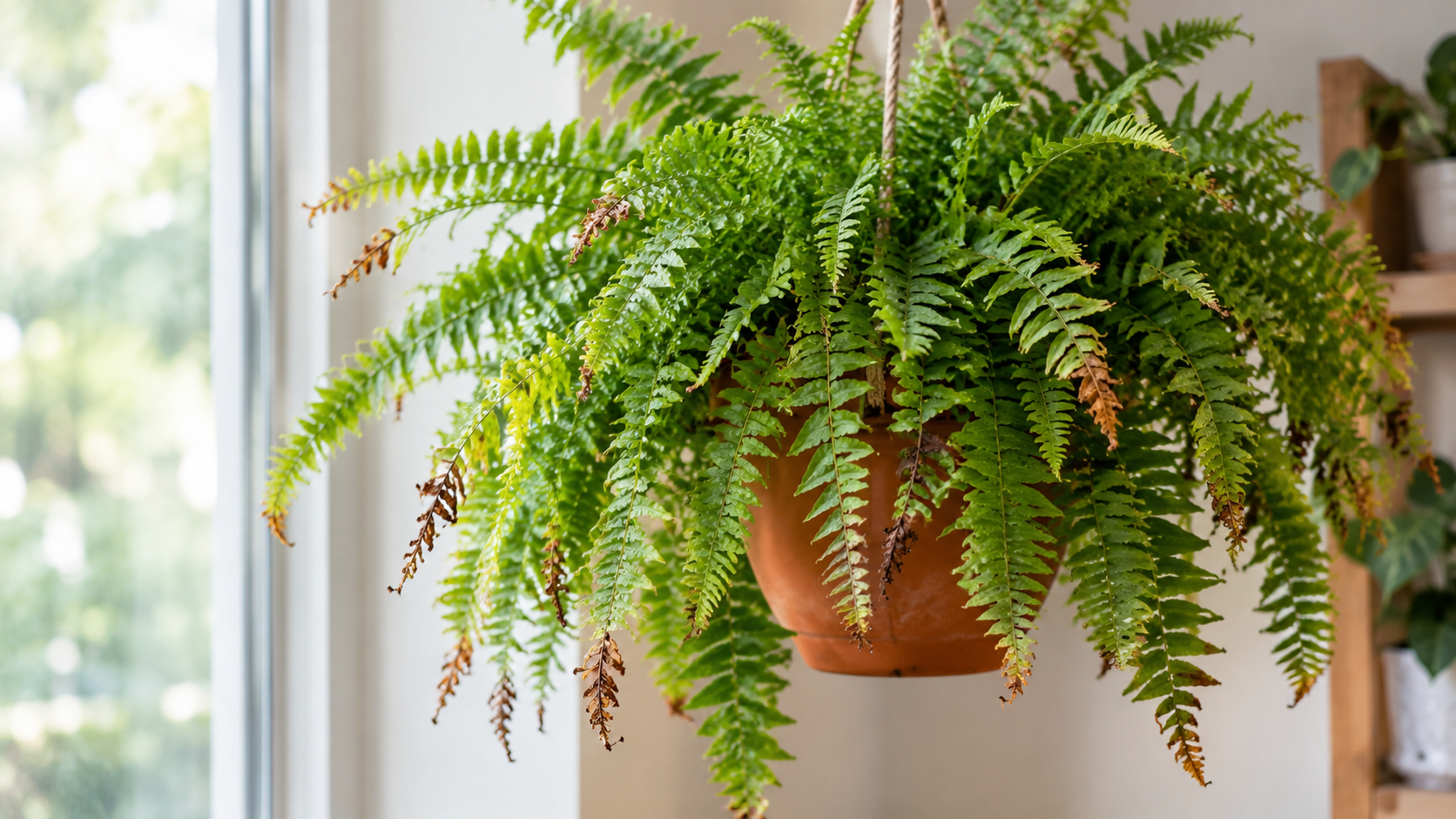
A fern with dry, brown leaves can be frustrating, especially when you water it regularly but its delicate fronds continue to lose their green color. The problem may be caused by dry indoor air, inconsistent watering, excessive sunlight, fertilizer buildup, or roots that are no longer functioning properly.
Before changing your entire care routine, look closely at where the drying begins and check the moisture of the potting mix. These details can help you identify the most likely cause and avoid treatments that could make the situation worse.
Different fern species have different needs, but many popular indoor ferns grow best with indirect light, consistent soil moisture, and higher humidity than a typical dry room provides.
1. Identify Where the Fern Leaves Are Drying
The location and pattern of the damage offer useful clues. Dry tips, completely brown fronds, and yellowing foliage can have different causes, so examine the plant before deciding what to change.
Brown tips and edges
When the ends of the leaflets turn brown while the rest of the frond remains green, possible causes include low humidity, irregular watering, fertilizer salts, or exposure to heat.
Dry indoor air is particularly challenging for delicate ferns. Air conditioning, heaters, and strong airflow can increase moisture loss from the foliage.
Entire fronds turning brown
If whole fronds become brown and brittle, check whether the potting mix has dried out excessively. Some older fronds may also die naturally, especially when growth slows during darker months.
However, widespread browning can also occur when roots are damaged by prolonged waterlogging. Check the soil and the condition of the plant rather than assuming it simply needs more water.
Yellowing combined with dry leaves
Yellowing accompanied by wilting or browning may indicate watering problems, root stress, or other unfavorable growing conditions.
If the soil remains wet for long periods and the plant continues to deteriorate, inspect drainage and consider whether root rot is developing.
2. Adjust Watering Without Keeping the Soil Waterlogged
Many indoor ferns prefer consistently moist potting mix, but this does not mean their roots should remain submerged in water. The goal is to maintain appropriate moisture while allowing excess water to drain freely.
How to tell when your fern needs water
Check the surface and the upper layer of the potting mix with your finger. Lift the pot if possible to assess its weight, and consider how quickly the soil usually dries in your home.
For many common tropical ferns, do not allow the entire root ball to dry out completely. However, watering frequency should depend on the species, pot size, temperature, light, and growing medium.
A practical watering routine
- Check the potting mix before watering rather than following a fixed calendar.
- When watering is needed, moisten the root ball thoroughly.
- Allow excess water to drain through the drainage holes.
- Empty the saucer or decorative outer pot so the roots do not sit in standing water.
- Check the moisture again before the next watering.
If the soil has become extremely dry and water runs straight through, apply water gradually so the root ball has an opportunity to absorb it.
If the soil is already wet, do not add more water simply because the leaves look wilted. First investigate whether the roots are struggling.
3. Increase Humidity Around the Fern
Low humidity is one of the most common reasons delicate indoor ferns develop brown tips and dry edges. Even when the soil is moist, the surrounding air may be too dry for the plant to maintain healthy foliage.
How to improve indoor humidity
- Use a room humidifier. This is one of the most reliable ways to increase humidity around a group of plants.
- Group compatible plants together. Their combined foliage can create a slightly more humid local environment, although the effect varies.
- Choose a naturally humid room. A bright bathroom may be suitable if it has enough indirect light and good air circulation.
- Monitor the environment. A small digital hygrometer can help you understand whether the air is consistently dry.
Some ferns benefit from moderate to high humidity, but the ideal level depends on the species. Boston ferns, for example, generally prefer humid conditions, while certain tougher-leaved ferns can tolerate ordinary indoor air more readily.
Does misting the leaves solve the problem?
Misting provides only a temporary increase in surface moisture and usually does not maintain higher humidity for long. It should not be the main solution when the room is persistently dry.
Instead, focus on improving the surrounding environment. Avoid leaving the foliage continuously wet in a poorly ventilated area, where moisture may encourage disease.
4. Find the Right Light: Bright but Indirect
Ferns commonly grow beneath the canopy of trees in their natural habitats. Many indoor species therefore prefer filtered or indirect light rather than prolonged exposure to strong direct sunlight.
A fern placed in intense afternoon sun near a window may develop scorched, faded, or dry-looking foliage. On the other hand, very low light can slow growth and make watering more difficult to manage because the potting mix dries more slowly.
Where should you place your fern?
Choose a location with bright, indirect daylight. An east-facing window may work well for many common ferns, while a south- or west-facing window may require a sheer curtain or greater distance from the glass.
Observe the plant throughout the day because sunlight intensity changes with the season and the position of the window.
If the fern has recently been moved from a shaded location to a brighter one, allow it to adjust gradually. Avoid making repeated location changes before assessing how the plant responds.
5. Check the Potting Mix and Root Health
Sometimes dry foliage is not caused by a lack of water in the room or a missed watering. The roots themselves may be unable to absorb water effectively.
Compacted potting mix, poor drainage, and prolonged saturation can interfere with root function. A severely root-bound plant may also be difficult to water evenly.
Signs that the roots need attention
Look for a combination of these symptoms:
- The soil remains wet for an unusually long time.
- Water drains poorly from the container.
- The plant wilts despite moist soil.
- Roots are densely circling the root ball.
- Roots are soft, dark, or unpleasant-smelling.
Root color varies among plants, so color alone is not a reliable diagnosis. Firmness, smell, and the overall condition of the root system are also important.
When to repot a fern
Repot if the growing medium has deteriorated, drainage is persistently poor, or the roots have filled the container to the point that watering becomes difficult.
Choose a pot with drainage holes and a suitable, moisture-retentive but well-aerated potting mix. Avoid moving the fern into an excessively large pot, since the extra soil may stay wet longer than the roots can use it.
Do not disturb the root ball unnecessarily when the plant is otherwise healthy. Fern roots and delicate fronds can be sensitive to rough handling.
6. Review Fertilizer Use and Water Quality
Ferns need nutrients for healthy growth, but excessive fertilizer can damage their foliage. A buildup of soluble salts may cause brown tips and leaf edges, particularly when fertilizer is applied too frequently or at a concentration that is too high.
Mineral deposits from irrigation water can also accumulate around the pot or on the soil surface. These deposits are a clue worth investigating, although their presence alone does not prove that they are responsible for the leaf damage.
What should you do?
- Review the fertilizer product and how often you apply it.
- Feed only when the plant is actively growing and according to its species-specific needs.
- Follow the recommended dilution and application instructions.
- Avoid fertilizing a fern that is severely stressed or has suspected root damage.
- If water quality is a concern, investigate whether your supply contains high levels of minerals or other substances that may affect sensitive plants.
For example, Boston ferns can develop browning from excessive fertilization. Their feeding needs also change with the season, so a routine appropriate during active growth may not be appropriate during slower winter growth
7. Remove Dry Fronds and Inspect for Pests
Completely brown, brittle fronds will not return to their original green condition. Removing them can improve the plant’s appearance and make it easier to inspect the remaining foliage.
How to prune damaged leaves
- Use clean, sharp scissors or pruning shears.
- Cut completely dead fronds close to the base without damaging the crown.
- If only the tips are brown, trim the dry portions carefully, following the natural shape of the leaflets.
- Leave healthy green tissue wherever possible.
Pruning improves appearance, but it does not correct the underlying problem. If new leaves continue to dry, reassess watering, humidity, light, and root health.
Check for pests
Inspect the undersides of the fronds, stems, and areas near the base of the plant. Scale insects, mealybugs, and mites can affect some indoor ferns.
Look for cotton-like clusters, small attached bumps, fine webbing, or unusual speckling. If you find suspicious signs, identify the pest before selecting a treatment.
Start with gentle, appropriate methods and avoid applying chemicals indiscriminately. Fern foliage can be sensitive to some pesticide sprays, so always follow the product label and test on a small area when the label permits.
8. Build a Simple Weekly Fern Care Routine
A consistent routine makes it easier to notice problems before the damage spreads. The goal is not to perform every task on the same day, but to check the plant and respond to its actual needs.
Check soil moisture
Feel the potting mix and water when appropriate for the species. Confirm that excess water can drain away.
Review light and temperature
Keep the fern away from harsh direct sun, heating vents, and cold drafts when these conditions are unsuitable.
Inspect new growth
Look for healthy emerging fronds, fresh browning, or distorted leaves.
Check for pests and damage
Examine the undersides of the leaves and remove completely dead fronds when necessary.
Keep a brief note of watering and environmental changes if the cause of the problem is unclear. This can help you recognize patterns without repeatedly changing several care conditions at once.
Frequently Asked Questions About Ferns with Dry Leaves
Can a fern recover after most of its leaves have dried?
Recovery may be possible if the crown and roots remain alive and healthy. Remove completely dead fronds, correct the growing conditions, and watch for new growth. If the roots and crown have extensively decayed, recovery is less likely.
Should I cut off every brown leaf?
Remove fully dead fronds, but do not remove healthy green foliage unnecessarily. If only the tips are brown, trim the damaged portions carefully while preserving the green tissue.
Is a bathroom a good place for a fern?
A bathroom can be suitable when it provides adequate indirect light, appropriate temperatures, and good air circulation. Humidity alone is not enough if the room is too dark or the potting mix remains waterlogged.
Why are my fern’s leaves drying even though I water it?
The surrounding air may be too dry, the plant may receive excessive sunlight, or its roots may be damaged. Check the soil before watering again, and investigate other conditions rather than assuming that more water is always the answer.
Restore Your Fern’s Growing Conditions One Step at a Time
A fern with dry leaves usually needs a closer look at its growing environment, not an immediate increase in watering or fertilizer. Start by checking the soil, the amount of indirect light, and the humidity around the plant.
Make the most likely adjustment first, remove dead foliage carefully, and observe the next emerging fronds. New growth is one of the most useful indicators of whether your revised care routine is helping.
With consistent attention and conditions suited to its species, a struggling fern may gradually produce healthier foliage.