Leaving home for a week can raise an important question for plant lovers: how can you keep your plants healthy without leaving taps running, overwatering pots, or returning to dry, wilted leaves? The answer depends on the type of plant, the weather, the amount of sunlight it receives, and how quickly its soil loses moisture.
Fortunately, most established houseplants can handle a short absence with the right preparation. Some need only a thorough watering before departure, while others benefit from a simple self-watering system or a temporary change of location. By matching the method to each plant’s needs, you can conserve water, reduce the risk of root rot, and avoid unnecessary expenses.
1. Check Which Plants Need Water While You Are Away
Before choosing a watering method, identify which plants are most likely to dry out during seven days without attention. Water requirements vary considerably, even among plants kept in the same room.
Plants that may need extra attention
- Tropical foliage plants: Peace lilies, calatheas, ferns, and some young tropical plants prefer consistently moist growing media. They may need additional protection in warm, dry rooms.
- Flowering plants: Many flowering species growing in small pots consume moisture quickly, particularly during active growth.
- Seedlings and newly transplanted plants: Their root systems are not yet extensive enough to access moisture throughout the pot, making them more vulnerable to drying out.
- Outdoor container plants: Small pots, hanging baskets, and window boxes can lose water rapidly in direct sunlight or windy conditions.
Plants that usually tolerate drier conditions
Succulents, cacti, snake plants, and ZZ plants generally store water in their leaves, stems, or underground structures. Many can tolerate a week without watering, depending on temperature, pot size, and the condition of their growing medium.
Do not automatically water these plants before leaving if the soil is already moist. Excess water can cause root damage, especially when drainage is poor.
2. Prepare Your Plants Before Leaving Home
The most effective way to save water is to reduce unnecessary evaporation and give each plant the amount of moisture it actually needs.
Follow this preparation checklist
- Check the soil moisture. Insert your finger about 2–5 cm into the growing medium, adjusting the depth for the pot size and plant species. If the soil is still damp, additional water may not be necessary.
- Water thoroughly when needed. For plants that require watering, apply water slowly until it begins draining through the bottom holes. Let the excess drain completely.
- Empty the saucers. Do not leave ordinary houseplants sitting in stagnant water for an entire week. Permanently saturated growing media can deprive roots of oxygen.
- Move plants away from intense sunlight. Choose a bright location with indirect light rather than a hot windowsill. Avoid placing shade-loving plants in complete darkness.
- Group compatible plants together. Grouping can help create a slightly more humid microclimate and make watering easier to manage.
These steps reduce water loss without forcing plants to remain in excessively wet soil.
3. Choose a Water-Saving Method That Fits Your Plants
Not every plant needs an automatic watering device. For a seven-day trip, choose the simplest reliable solution for each group of plants.


5
Method 1: Thorough watering before departure
This is often sufficient for established plants in medium or large pots, particularly in cooler conditions.
Water only when the growing medium has reached the appropriate dryness for that species. Apply water evenly, allow drainage, and return the plant to its usual suitable environment.
Best for: Established pothos, many philodendrons, and other moderately drought-tolerant foliage plants.
Limitation: Small pots, thirsty species, and plants exposed to hot, dry air may need more support.
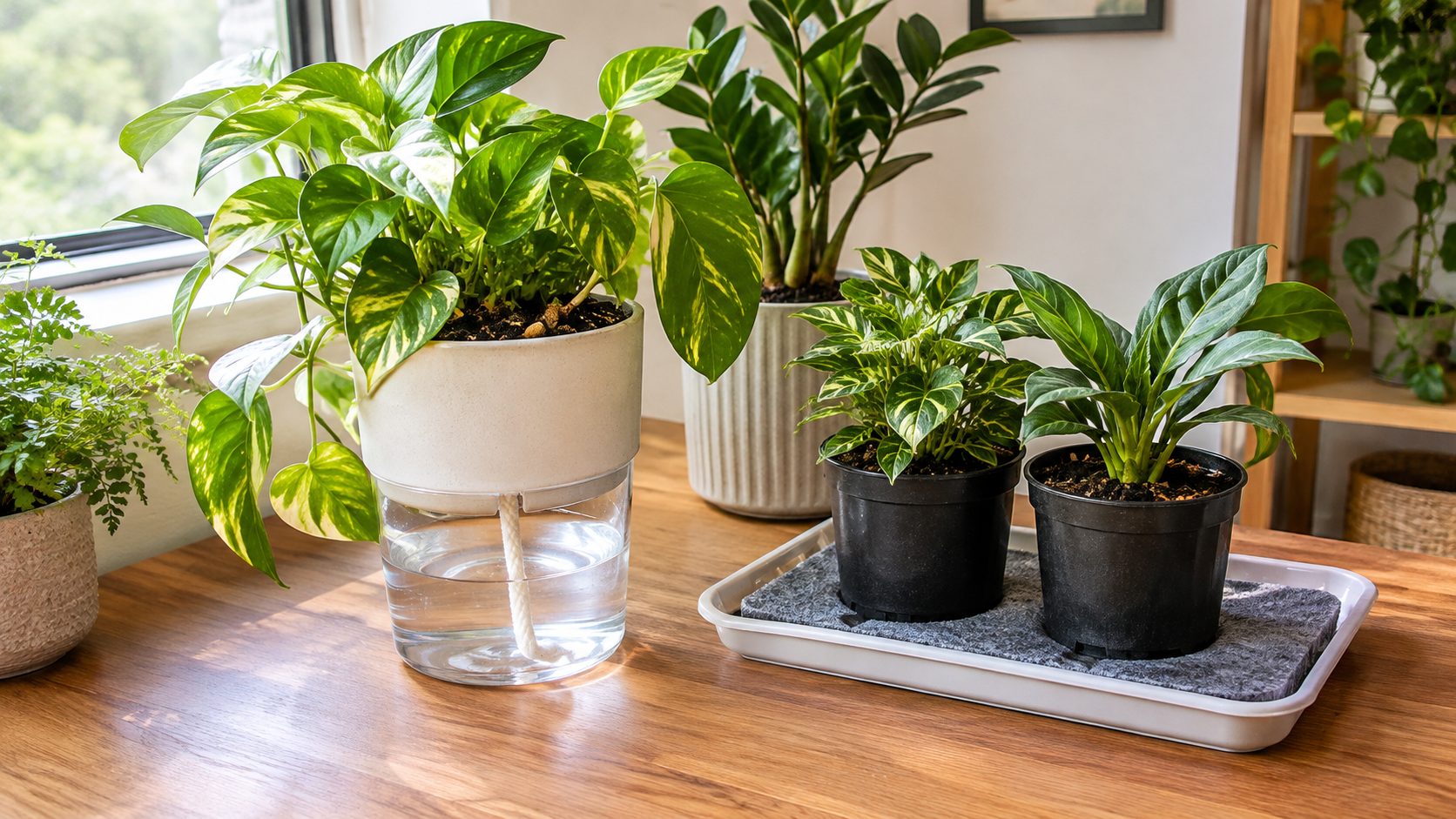
Method 2: A cotton-wick self-watering system
A wick draws moisture from a reservoir into the growing medium through capillary action. It can provide a gradual water supply without keeping the roots submerged.
You will need:
- A clean container to hold water.
- A cotton cord or suitable absorbent wick.
- A stable surface for the water reservoir.
To set it up, place one end of the wick several centimeters into the growing medium, close to the root zone without damaging major roots. Place the other end in the water reservoir, ensuring that it remains submerged as the water level falls.
Test the arrangement before traveling. Some materials transfer water too slowly, while others can keep the soil excessively wet. A wick also works poorly when the growing medium resists absorbing water.
Best for: Plants that prefer relatively even moisture, provided the setup has been tested.
Method 3: A capillary mat
Capillary mats are absorbent materials that transfer moisture to pots through their drainage holes. They can work well when several small houseplants need similar watering conditions.
- Place the mat on a waterproof, level tray.
- Wet it evenly according to the product instructions.
- Place suitable pots with drainage holes on the mat.
- Ensure that the mat can access a water supply if the system is designed for a reservoir.
- Test moisture levels over several days.
Plastic nursery pots generally work better than containers whose bases prevent contact with the mat.
Important: This method is not suitable for every plant. Cacti and succulents that require drying between waterings can suffer if their growing medium remains continuously moist.
Method 4: A small drip-irrigation system
For balconies, patios, vegetable containers, or larger plant collections, a drip system with a timer can deliver measured quantities of water directly to the root zone.
Use adjustable emitters when plants have different water requirements. Check the system for leaks, clogged outlets, and uneven delivery before leaving.
A timer alone does not guarantee water savings. Excessive run times, leaks, and poorly positioned emitters can waste water or saturate the soil.
Best for: Multiple outdoor pots and gardeners who travel frequently.
4. Reduce Water Loss Without Harming Plant Growth
Water conservation does not mean leaving plants thirsty. It means slowing unnecessary moisture loss while maintaining conditions that support healthy roots.
Adjust light and temperature
Move portable pots away from direct afternoon sunlight, radiators, air-conditioning outlets, and other sources of intense heat or airflow. A cooler room with suitable indirect light can slow evaporation and transpiration.
Do not place every plant in a dark bathroom simply because it is cooler. Most foliage plants still need adequate light, and some species have specific humidity and temperature requirements.
Use mulch for outdoor containers
A thin layer of suitable organic mulch can help slow evaporation from the soil surface of larger outdoor containers. Keep mulch away from stems and avoid using a thick layer in small pots that already retain moisture well.
For indoor plants, changing the soil surface is not always necessary. Correct watering, suitable potting media, and appropriate light conditions usually make a bigger difference.
Collect and reuse suitable water
Rainwater collected in a clean container can be useful for many ornamental plants. If you reuse household water, avoid water containing detergents, cleaning chemicals, grease, or excessive salts. Use only water sources appropriate for the plant and the intended purpose.
There is little benefit in setting up a complicated collection system for a single week away if a simple, well-tested watering method will suffice.
5. Avoid Common Mistakes Before a Vacation
Several popular watering tricks can cause more harm than good when used without considering the plant’s needs.
- Overwatering every pot: Adding extra water does not guarantee a longer supply. Saturated soil may reduce oxygen availability and damage roots.
- Leaving pots in deep saucers of water: This can cause prolonged waterlogging, especially in plants that need good drainage.
- Using an untested wick: A wick may deliver too much or too little water, depending on its material, thickness, and placement.
- Moving plants into complete darkness: Reduced evaporation does not compensate for inadequate light over time.
- Pruning healthy foliage unnecessarily: Removing large amounts of leaves can stress plants. Only remove dead or damaged material when appropriate.
- Applying fertilizer just before leaving: Fertilizer does not replace water and may increase stress if applied incorrectly. Maintain the plant’s normal feeding schedule rather than adding extra fertilizer as a precaution.
A simple test is often more valuable than a complicated arrangement. If you have several days before departure, observe how quickly each pot dries under the planned conditions.
6. Adapt Your Plan to Different Plant Types
The right strategy depends on more than the length of your trip.
| Plant type | Suggested approach for seven days |
|---|---|
| Cacti and succulents | Check the soil and water only when appropriate for the species and growing medium. |
| Pothos and philodendrons | Check moisture, water when needed, and consider a wick for plants that dry quickly. |
| Ferns and moisture-loving plants | Use a tested moisture-retention method or arrange for someone to check them in warm conditions. |
| Orchids | Follow the needs of the particular orchid and potting medium; avoid leaving roots standing in water. |
| Seedlings and newly transplanted plants | Arrange reliable monitoring or a tested watering system because they dry out quickly. |
| Outdoor vegetables in pots | Prioritize them during hot weather and consider calibrated drip irrigation. |
These are general starting points, not fixed watering schedules. Pot size, root development, growing medium, temperature, humidity, and seasonal growth all affect water requirements.
7. A Practical Seven-Day Preparation Plan
If you have a week before departure, use the time to prepare rather than setting up an unfamiliar system at the last minute.
Seven days before leaving
Inspect your plants, identify moisture-sensitive species, check drainage holes, and note which pots dry out fastest.
Three to five days before leaving
Set up any wick, capillary mat, or drip system. Check whether moisture is moving into the soil at a suitable rate.
One day before leaving
Adjust plant positions, confirm the reservoir has enough capacity for the expected demand, and check that no containers are leaking.
On departure day
Check soil moisture individually, water only plants that need it, allow excess water to drain, and confirm that any self-watering system is functioning.
If you are leaving during a heatwave or have many delicate plants, ask a trusted person to check the collection midway through the week. Even a brief inspection can identify an empty reservoir, a blocked emitter, or an unexpectedly dry pot.
8. What to Do When You Return Home
Resist the temptation to water every plant immediately. First, inspect the soil, leaves, and drainage.
A plant with drooping leaves and dry soil may need water. However, drooping leaves can also indicate root damage or waterlogged soil. Check the growing medium before deciding what to do.
If a pot has dried so thoroughly that water runs down the sides without soaking in, apply water slowly in several passes. For suitable small pots, briefly soaking the root ball can help rehydrate it, but only if the species tolerates this approach. Allow the container to drain completely afterward.
Wait before removing damaged leaves or applying fertilizer. Give stressed plants time to recover, then resume their normal care routine according to their condition.
Make Your Next Week Away Easier With Less Water
The most reliable approach combines three decisions: identify which plants genuinely need moisture, reduce avoidable water loss, and choose a watering method suited to each plant.
For many established houseplants, checking the soil and watering appropriately before departure is enough. Plants that dry out quickly may need a tested wick or capillary mat, while outdoor containers can benefit from calibrated drip irrigation. Succulents and other drought-adapted plants often need less intervention, not more.
Start preparing several days ahead, observe how each plant responds, and make adjustments based on actual soil moisture rather than a fixed schedule. This simple habit can protect your plants during a week away while helping you use water more responsibly.